
Dismisses Obi’s Rigging Allegation In President’s Favour
Says He Failed To List Specific Polling Units
Strikes Down APM’s Petition Against Tinubu, Shettima
President Hails Judgment
THE presidential election tribunal, on Wednesday, September 6, 2023, ruled that the Peoples Democratic Party (PDP) and its candidate, Atiku Abubakar; Labour Party (LP) and its candidate, Peter Obi; and Allied Peoples Movement (APM) failed to prove their allegations of electoral malpractice against the ruling All Progressives Congress (APC) and its candidate, president Bola Tinubu in the February 25 elections.
The trio had challenged the Independent National Electoral Commission’s (INEC) declaration of the former Lagos State governor, who won 37 per cent of the votes, winner, praying the tribunal to void the declaration on allegations of irregularities.
But the Justices dismissed all the allegation by Obi, including fraud, saying INEC violated the law, as well as that Tinubu was ineligible to run.
The President, while reacting in a statement by his Special Adviser on Media and Publicity, Ajuri Ngelale, welcomed the judgment with a sense of solemn responsibility and preparedness to serve all Nigerians.
According to the statement: “President Bola Ahmed Tinubu, on Wednesday, has assured Nigerians of his renewed and energised focus on delivering his vision of a unified, peaceful and prosperous nation, following the judgement by the tribunal in Abuja.
“Tinubu welcomes the judgment with an intense sense of solemn responsibility and preparedness to serve all Nigerians, irrespective of all diverse political persuasions, faiths and tribal identities.
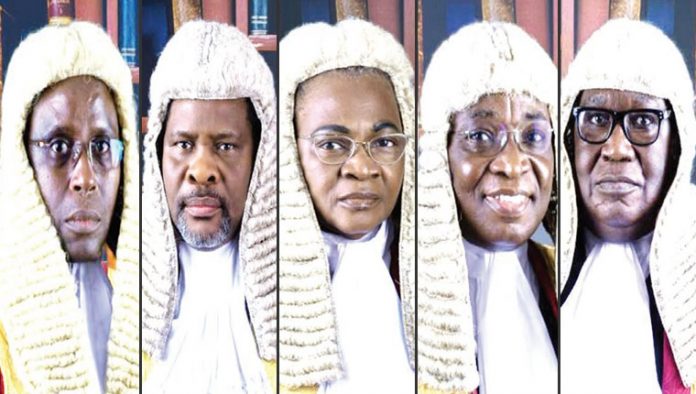
“The President recognises the diligence, undaunted thoroughness and professionalism of the five-member bench, led by Justice Haruna Tsammani, in interpreting the law. The President affirms that his commitment to the rule of law and the unhindered discharge of duties by the tribunal, as witnessed in the panel’s exclusive respect for the merits of the petitions brought forward, further reflects the continuing maturation of Nigeria’s legal system and the advancement of Africa’s largest democracy at a time when our democratic system of government is under test in other parts of the continent.
“The President believes the presidential candidates and political parties that have lawfully exercised their rights by participating in the 2023 general elections and the judicial process, which followed, have affirmed Nigeria’s democratic credentials.
“The President urges his valiant challengers to inspire their supporters in the trust that the spirit of patriotism will now and forever be elevated above partisan considerations, manifesting into support for our government to improve the livelihood of all Nigerians.
“Once more, Tinubu thanks Nigerians for the mandate given to him to serve our country, while promising to meet and exceed their expectations, by the grace of God Almighty, and through very diligent hardwork with the team that has been put in place for that sole purpose.”
The tribunal, in its preliminary ruling, delivered by Justice Abba Mohammed, held that Obi and LP did not by way of credible evidence, establish their allegation that the election was characterised by manifest corrupt practices.
It held that though the petitioners alleged that the election was marred by irregularities, they, however, failed to give specific details of where the alleged infractions took place, noting that whereas Obi and the LP insisted that the election was rigged in 18, 088 polling units across the federation, they were unable to state the locations of the said polling units.
It also held that Obi’s allegation that fictitious results were allocated to Tinubu and the APC by INEC was not proved, more so, as the petitioners were unable to state the figures they alleged were reduced from election results they got in different states of the federation, especially Ondo, Oyo, Rivers, Yobe, Borno, Taraba, Osun and Lagos.
The tribunal held that the petitioners equally failed to state the polling units where over-voting occurred or the exact figures of unlawful votes that were credited to Tinubu by INEC, stressing that though Obi and LP said they would rely on spreadsheets, forensic report and expert analysis of their expert witnesses, they failed to attach the documents to the petition or serve same on the respondents as required by the law.
It noted that though the petition contained serious allegations that bordered on violence, non-voting, suppression of votes, fictitious entry of election results and corrupt practices, the petitioners, however, failed to give particulars of specific polling units where the incidences took place, adding that several portions of the petition that contained the allegations, were “vague, imprecise, nebulous and bereft of particular materials.”
It, therefore, struck out paragraphs 9, 60, 61, 66, 67, 68, 69, 70, 71, 72, 73, 76, 77, 78, 83 and 89 of the petition.
Still on the issue of substantial non-compliance with the provisions of the law, especially with regard to non-transmission of result sheets to INEC Result Viewing Portal (IReV), the court held that there was no law that says INEC must transfer or transmit the results of the election from the polling units electronically, as it only empowers it to decide the means of collation of results of elections.
The tribunal rejected the European Union (EU) report on the polls, saying it was not tendered by an official of the body.
It, however, dismissed the contention of the respondents that Obi was not validly nominated by the LP to contest the election. The respondents had argued that Obi left the PDP on May 24, 2022 and joined the LP on May 27 the same year and that as at May 30, 2022, Obi was not a valid member of the LP and could not have duly participated in its presidential primary election.
They insisted that his name could not have been contained in the membership register of the LP, which ought to be submitted to INEC, 30 days before the primary election held.
But the tribunal, in its ruling, held that the issue of membership is an internal affair of a political party, which is not justiceable, and that only the LP has the prerogative of determining who is its member; hence the respondents lacked the legal right to query Obi’s membership of the LP.
The panel also held that contrary to Tinubu and APC’s contention, the petitioners were not under any obligation to join Atiku, who came second in the election, or his party, PDP, in the case, as they were not statutory respondents or necessary parties to the petition.
The tribunal had earlier struck out the Allied Peoples Movement’s (APM) petitions against Tinubu and his running mate in the election, Vice President, Kashim Shettima, for lack of merit, saying its case to nullify Tinubu’s election was “incompetent.”
It held that issues raised by APM in its petition contained pre-election matters that could only be determined by the Federal High Court and equally dismissed its petition against INEC and four others- APC, Tinubu, Shettima and Kabiru Masari, saying the petitioners failed to prove their arguments and the petition was void of merits, even as it upheld preliminary objections raised by all the respondents to challenge the competence of the petition.
Tsammani held that since the petition centred on Tinubu’s qualification or otherwise to contest the election, the APM ought to have gone to court within 14 days after his was nominated by the APC, more so as the law did not allow a political party to query the process adopted by another political party in nominating its candidate.
Tsammani held that invalid nomination or double nomination did not qualify as a ground for disqualification in respect of presidential election, as provided in Sections 131 and 137 of the 1999 Constitution (as amended).
On the issues of Tinubu’s conviction and dual citizenship, the tribunal held that these issues were incompetent and liable to be struck out and same were indeed struck out.
On the inability of the election officers to transmit, the tribunal noted that of the 27 witnesses called by the petitioner, 10 were polling unit agents who testified as to how the elections were conducted in their different polling units. All 10 of the witnesses testified that the voting went well and was peaceful in their different polling units, but said they could not upload results electronically to the INEC IREV; hence entered the results manually and took the same to the ward and or state collation centre.
The witnesses were emphatic that voting went well, party agents signed the results, but the only difficulty was in uploading the results electronically.
One of the panel members, Justice Adah, rejected Atiku’s 15 witnesses and 37 exhibits they tendered, saying their statements on oath were not filed along with the petition.
Justice Moses Ugo highlighted faults in Atiku’s petition, saying it was filed with generic allegations and the petition did not list polling units where election malpractices happened.


