
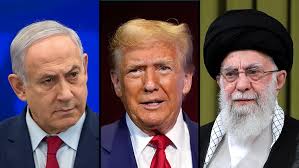
*Israeli Preparing To Strike Iran If Talks With US Fail
*Trump Waved Off Strike After Divisions Emerged In His Administration
HEAD of the United Nations (UN) International Atomic Energy Agency (IAEA), Rafael Grossi, has alerted the world that Iran was not far from developing and having an atomic bomb.
The head of the UN nuclear watchdog was quoted as saying in a Le Monde interview published on Wednesday, April 16, just hours before a visit to Tehran, the Iranian capital, that though the Shiite Arab country still had a way to go before acquiring the bomb: “They’re not far from it, you have to acknowledge.”
Grossi, who was scheduled to arrive in Iran later on Wednesday for talks with senior officials, compared the development of a nuclear weapon to a jigsaw puzzle, saying that Iran “has the pieces and they could eventually put them together one day.”
The UN watchdog has been tasked with overseeing Iran’s compliance with the 2015 nuclear deal, which collapsed after United States President, Donald Trump, withdrew from it during his first term.
Meanwhile, Israel is reported to be stockpiling US weapons and preparing for a potential military strike on Iran if nuclear talks with Washington collapse.
According to Israeli media, the Zionist country, wich considers Iran an enemy and sponsor of terror in the region, was preparing militarily for the possibility of striking Iran if ongoing nuclear negotiations between Tehran and Washington break down, according to Israeli newspaper Maariv.
As part of this preparation, the Israeli military has begun stockpiling large quantities of advanced American-made weaponry, delivered through an ongoing US transfer of arms to Israel.
In recent weeks, Israel’s Air Force has received bunker-buster bombs, as well as heavy and medium-weight munitions, ranging from one to 1.5 tons, Maariv reported.
These weapons have arrived by sea and air, with dozens of US cargo planes, including Hercules aircraft, landing at Nevatim Air Base in the Negev and at Ben Gurion Airport.
According to Maariv, the shipments include JDAM kits, which turn unguided bombs into precision-guided munitions.
Most of the recent weapons deliveries reportedly came from US military stockpiles in Europe and other regions.
A senior figure in Israel’s weapons industry told the Israeli daily that the Defence ministry had ordered the weapons to replenish the Air Force’s emergency stockpiles.
The shipments also included additional types of bombs, missiles, defensive flare systems to protect aircraft from heat-seeking missiles, and an additional THAAD (Terminal High Altitude Area Defence) battery, which was reportedly used just last week to intercept a ballistic missile fired from Yemen.
While the Israeli military has not commented publicly on the transfers, the report indicated that the build-up was not only geared toward the ongoing war in Gaza, but also primarily intended to prepare for a scenario in which diplomacy with Iran fails and military confrontation becomes likely.
Meantime, Iran’s Foreign Minister, Abbas Araghchi, has criticised US Special Envoy to the Middle East, Steve Witkoff, for making “contradictory” and “not constructive” statements about the nuclear talks with Tehran.
Araghchi told reporters after a weekly cabinet meeting said on Wednesday, April 16, that “contradictory” statements from the US “do not help” the negotiation process, adding that Tehran “needs to hear the real position” of Washington at their next meeting, according to IRNA news agency.
“If they come with a constructive position, I hope we can start negotiations on the framework of a possible deal. If they do not and continue to present contradictory positions, the work will become difficult.
“Negotiations can only move forward on the basis of mutual respect,” he added.
Araghchi warned that continued US pressure during talks would “not produce any gains,” adding that Iran was open to building trust over international concerns, but will not compromise on what it sees as its sovereign right to nuclear enrichment.
On Saturday, Tehran and Washington held their first round of “indirect” talks since Trump’s return to the White House in January, with delegations led by Araghchi and Witkoff.
The meeting was held in Muscat and mediated by Omani Foreign Minister, Badr al-Busaidi.
The next round is set to be held in Muscat on April 19.
In the interim, Israel’s plan to strike Iranian nuclear sites as soon as next month, but was waved off by Trump in recent weeks in favour of negotiating a deal with Tehran to limit its nuclear programme, according to administration officials and others briefed on the discussions.
Any Israeli attack on Iranian nuclear facilities would require US assistance, but some administration officials had doubts.
Trump made his decision after months of internal debate over whether to pursue diplomacy or support Israel in seeking to set back Iran’s ability to build a bomb, at a time when Iran has been weakened militarily and economically.
The debate highlighted fault lines between historically hawkish American cabinet officials and other aides more skeptical that a military assault on Iran could destroy the country’s nuclear ambitions and avoid a larger war.
It resulted in a rough consensus, for now, against military action, with Iran signaling a willingness to negotiate.
Israeli officials had recently developed plans to attack Iranian nuclear sites in May and were prepared to carry them out, and at times were optimistic that the US would sign off.
The goal of the proposals, according to officials briefed on them, was to set back Tehran’s ability to develop a nuclear weapon by a year or more.
Almost all of the plans would have required US help, not just to defend Israel from Iranian retaliation, but also to ensure that an Israeli attack was successful, making the US a central part of the attack itself.
For now, Trump has chosen diplomacy over military action. In his first term, he tore up the Iran nuclear deal negotiated by the President Barack Obama administration.
But in his second term, eager to avoid being sucked into another war in the Middle East, he has opened negotiations with Tehran, giving it a deadline of just a few months to negotiate a deal over its nuclear programme.
Earlier this month, Trump informed Israel of his decision that the US would not support an attack during discussion with Prime Minister Benjamin Netanyahu, when the latter visited Washington last week, using an Oval Office meeting to announce that the US was beginning talks with Iran.
In a statement delivered in Hebrew after the meeting, Netanyahu said an agreement with Iran would work only if it allowed the signers to “go in, blow up the facilities, dismantle all the equipment, under American supervision, with American execution.”
This article, based on conversations with multiple officials briefed on Israel’s secret military plans, most of the people interviewed spoke on the condition of anonymity to discuss military planning, and confidential discussions inside the Trump administration, indicated that Israel has long planned to attack Iranian nuclear facilities, rehearsing bombing runs and calculating how much damage it could do with or without American help.
But support within the Israeli government for a strike grew after Iran suffered a string of setbacks in April last year after Israeli attacks and most of Iran’s ballistic missiles were unable to penetrate American and Israeli defenses.
Iran’s proxy, Hezbollah, was decimated by an Israeli military campaign last year, and the subsequent fall of the government of President Bashar al-Assad in Syria eliminated a Hezbollah and Tehran ally and cut off a prime route of weapons smuggling from Iran.
Air defense systems in Iran and Syria were also destroyed, along with the facilities that Iran uses to make missile fuel, crippling the country’s ability to produce new missiles for some time.
Initially, at the behest of Netanyahu, senior Israeli officials updated their American counterparts on a plan that would have combined an Israeli commando raid on underground nuclear sites with a bombing campaign, an effort that the Israelis hoped would involve American aircraft.
But Israeli military officials said the commando operation would not be ready until October, although Netanyahu wanted it carried out more quickly.
Israeli officials began shifting to a proposal for an extended bombing campaign that would have also required American assistance, according to officials briefed on the plan.
Some American officials were at least initially more open to considering the Israeli plans. Gen. Michael E. Kurilla, the head of US Central Command, and National Security Adviser, Michael Waltz, both discussing how the US could potentially support an Israeli attack if Trump backed the plan, according to officials briefed on the discussions.
With the US intensifying its war against the Iran-backed Houthi militants in Yemen, Kurilla, with the blessing of the White House, began moving military equipment to the Middle East.
A second aircraft carrier, Carl Vinson, is now in the Arabian Sea, joining the carrier, Harry S. Truman, in the Red Sea.
The US also moved two Patriot missile batteries and a Terminal High Altitude Area Defense system, known as a THAAD, to the Middle East.
Around a half-dozen B-2 Bombers capable of carrying 30,000-pound bombs essential to destroying Iran’s underground nuclear programme were dispatched to Diego Garcia, an island base in the Indian Ocean.
Moving additional fighter aircraft to the region, potentially to a base in Israel, was also considered.
All of the equipment could be used for strikes against the Houthis, whom the US has been attacking since March 15 in an effort to halt their strikes against shipping vessels in the Red Sea.
But US officials said privately that the weaponry was also part of the planning for potentially supporting Israel in a conflict with Iran.
Even if the US decided not to authorise the aircraft to take part in a strike on Iran, Israel would know that the American fighters were available to defend against attacks by an Iranian ally.
There were signs that Trump was open to US support for Israeli military action against Iran, which it has long accused of giving the Houthis weapons and intelligence, and of exercising, at least, a degree of control over the group.
On March 17, as Trump warned the Houthis in Yemen to stop their attacks, he also called out Iran, saying it was in control of the Houthis.
“Every shot fired by the Houthis will be looked upon, from this point forward, as being a shot fired from the weapons and leadership of IRAN,” he wrote in a social media post, adding: “IRAN will be held responsible, and suffer the consequences, and those consequences will be dire!”
There were many reasons that Israeli officials expected Trump to take an aggressive line on Iran. In 2020, he ordered the killing of Gen. Qassim Suleimani, the commander of Iran’s most elite military unit.
And Iran sought to hire hit men to assassinate Trump during last year’s presidential campaign, according to a Justice Department indictment.
But inside the Trump administration, some officials were becoming skeptical of the Israeli plan.
In a meeting this month, one of several discussions about the Israeli plan, Tulsi Gabbard, the Director of National Intelligence, presented a new intelligence assessment that said the buildup of American weaponry could potentially spark a wider conflict with Iran, a development the US did not want.
A range of officials echoed Gabbard’s concerns in the various meetings, with Susie Wiles, White House Chief of Staff; Defense Secretary, Pete Hegseth; and Vice President, JD Vance, all voicing doubts about the attack.
Even Waltz, frequently one of the most hawkish voices on Iran, was skeptical that Israel’s plan could succeed without substantial American assistance.
The recent meetings came shortly after the Iranians said that they were open to indirect talks, communications through an intermediary.
In March, Trump sent a letter offering direct talks with Iran, an overture that Ayatollah Ali Khamenei, the Supreme Leader, had appeared to reject.
But on March 28, a senior Iranian official sent a letter back, signaling openness to indirect talks.
There is still significant debate within Trump’s team about what kind of agreement with Iran would be acceptable.
The administration has sent mixed signals about what kind of deal it wants, and what the consequences for Iran would be if it failed to agree.
In one discussion, Vance, with support from others, argued that Trump had a unique opportunity to make a deal.
If the talks failed, Trump could then support an Israeli attack, Vance said, according to administration officials.
During a visit to Israel earlier this month, Kurilla told officials there that the White House wanted to put the plan to attack the nuclear facility on hold.
Netanyahu called Trump on April 3, and according to Israeli officials, Trump told him he did not want to discuss Iran plans on the phone and invited Netanyahu to come to the White House. Netanyahu arrived in Washington on April 7.
While the trip was presented as an opportunity for him to argue against Trump’s tariffs, the most important discussion for the Israelis was their planned strike on Iran. But while Netanyahu was still at the White House, Trump publicly announced the talks with Iran.
In private discussions, Trump made clear to Netanyahu that he would not provide American support for an Israeli attack in May while the negotiations were playing out, according to officials briefed on the discussions.
The next day, Trump suggested that an Israeli military strike against Iran remained an option, saying: “If it requires military, we’re going to have military. Israel will, obviously, be the leader of that.”
After Netanyahu’s visit, Trump assigned John Ratcliffe, the CIA Director, to travel to Jerusalem.
Last Wednesday, Ratcliffe met with Netanyahu and David Barnea, the Head of the Mossad spy agency, to discuss various options for dealing with Iran.
In addition to talks and strikes, other options were discussed, including covert Israeli operations conducted with US support and more aggressive sanctions enforcement, according to a person briefed on Mr. Ratcliffe’s visit.
Brian Hughes, a National Security Council spokesman, said the administration’s “entire national security leadership team” was committed to Trump’s Iran policy and efforts “to ensure peace and stability in the Middle East.”
He added: “President Trump has been clear: Iran cannot have a nuclear weapon, and all options remain on the table.
“The President has authorised direct and indirect discussions with Iran to make this point clear. But he’s also made clear this cannot go on indefinitely.”
The White House and the CIA did not respond to requests for comment, while the Office of the Director of National Intelligence referred questions to the National Security Council, with the Defense Department declining to comment.
Netanyahu’s office and the Israel Defense Forces also declined to comment.


