
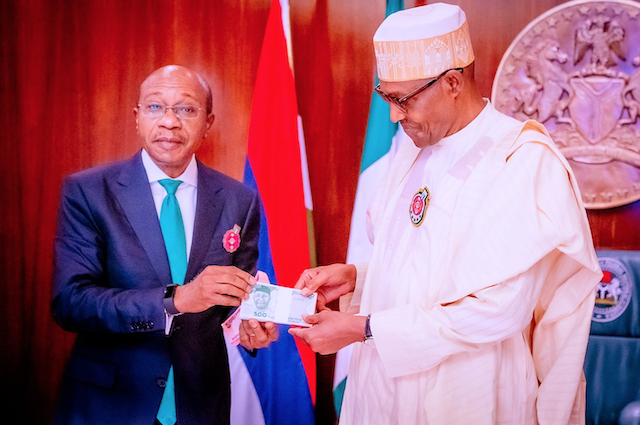
PRESIDENT Muhammadu Buhari, on Wednesday, November 23, unveiled the new Naira banknotes, saying the redesigned currencies were locally produced by the Nigerian Security Printing and Minting (NSPM) Plc.
Speaking at the inauguration of the new notes shortly before the weekly Federal Executive Council (FEC) meeting in Abuja, Buhari, while giving reasons for his approval to the Central Bank of Nigeria (CBN) to redesign the N200, N500 and N1,000 notes, explained that the new notes have been fortified with security features that make them difficult to counterfeit, adding that the new notes would help CBN to design and implement better monetary policy objectives, as well as enrich the collective memory of Nigeria’s heritage.
The President commended the CBN Governor, Mr. Godwin Emefiele, and his deputies for the initiative, as well as the managing director, executive directors and staffers of NSPM PLC “for working tirelessly with the apex bank to make the currency redesign a reality and for printing the new notes within a comparatively short time.”
Buhari stated that international best practice requires central banks and national authorities to issue new or redesigned currency notes every five to eight years, noting that it was now almost 20 years since the last major redesign of the country’s local currency was done; hence the exercise was long overdue.
He stated: “A cycle of banknote redesign is generally aimed at achieving specific objectives, including, but not limited to improving security of banknotes.
“It is also aimed at mitigating counterfeiting, preserving the collective national heritage, controlling currency in circulation and reducing the overall cost of currency management.
“As is known, our local laws, specifically the Central Bank of Nigeria Act of 2007, grants the CBN the power to issue and redesign the naira.
“In line with this power, the bank’s governor approached me earlier in this year to seek my permission to embark on a currency redesign project. I considered all the facts and reasons presented before me by the Central Bank.”
He, therefore, expressed the hope that the new notes would address the urgent need to take control of currency in circulation, address the menace of hoarding naira banknotes outside the banking system and curb the shortage of clean and fit banknotes in circulation, adding that the redesigned notes would also address the increase in counterfeiting of high-denomination naira banknotes.
“It is on this basis that I gave my approval for the redesign of the N200, N500 and N1, 000 banknotes. While this may not be apparent to many Nigerians, only four out of the 54 African countries print their currencies in their countries, and Nigeria is one. A majority of African countries print their currencies abroad and import them the way we import other goods.
“That is why it is with immense pride that I announce to you that these redesigned currencies are locally-produced right here in Nigeria by NSPM Plc,” he said.
In his remark, Emefiele thanked the President for his unwavering support for the redesign and distribution of the new notes. He assured that the redesigned currency notes can never be counterfeited, saying the CBN would redesign the notes after every five to eight years to forestall such occurrence.
Emefiele also stressed that there would be heavy restriction on the volume of cash that could be withdrawn over the counter, as the apex bank would work with the Economic and Financial Crimes Commission (EFCC) to monitor the purpose of all heavy transactions.
The new notes will be formerly launched on December 15 and will circulate side-by-side the old notes until January 31, next year, when the old notes will cease to be legal tender.
While the CBN was yet to disclose the distinct features of the redesigned banknotes, a major notable difference is the colours, but the portraits and dimensions appear to remain the same.
The old N1, 000, N500 and N200 banknotes are in 151mm x 78mm dimensions. The portraits on the new notes remained the same as those on the old notes, with Alhaji Aliyu Mai Bornu and Dr. Clement Isong on the N1, 000 note, Dr. Nnamdi Azikiwe on the N500 notes and Sir Ahmadu Bello on the N200 notes.


