
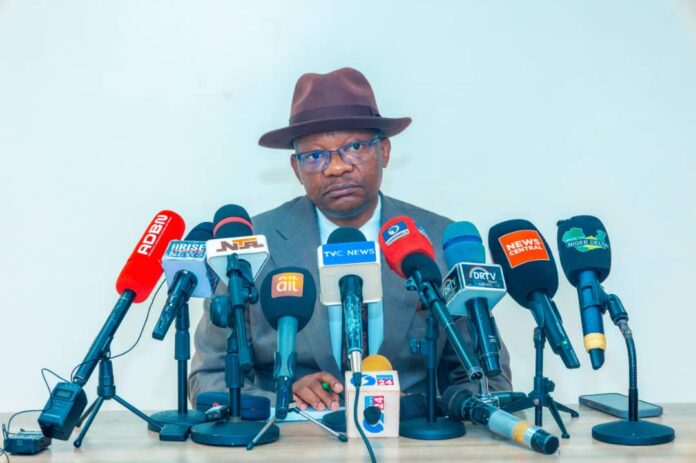
*No Fight Among Commissioners, Govt Focused On Projects, Says Aniagwu
*Labour Gears For Face-off With Govt.
THE Delta State Government has insisted on the dress code for civil servants, saying the rules were not new, but anchored on provisions of the Civil Service Rules, particularly Section 04314 on page 42.
Briefing journalists in Asaba, Commissioner for Works (Rural Roads) and Public Information, Charles Aniagwu, said just as every profession has an expected mode of dressing, the civil service requires its workforce to appear decent and corporate.
According to him: “When you come to work in spaghetti straps or slippers, you demean the image of the service. The civil service is not a free party where people can dress as they please.
“We are not telling you how to dress at home, in church or at nightclubs, but during official hours, we expect decency.”
Aniagwu argued that enforcing the dress code was about protecting the image of government and ensuring respect for public institutions, noting that outcry over the rules were unnecessary distrations.
The commissioner also expressed support for the screening of civil servants, warning that government will not condone falsification of age, abuse of leave of absence or indecent dressing in the workforce, adding that the exercise was designed to sanitise the service and restore integrity.
He explained that many officers had manipulated their records by presenting unrealistic primary school certificates that made it appear as though they began school immediately after birth, noting that government would not reverse the decisions, especially on officers advised to proceed on retirement.
He stated that those who had abused leave of absence by staying abroad for years while still drawing salaries from the state’s payroll would be removed, with steps taken to recover funds illegally earned.
“If there is anybody that has been advised by the screening committee to retire, government fully supports that decision.
“We cannot continue to accommodate individuals who falsify their age or live abroad while collecting salaries meant for those working here.”
Reiterating commitment to reforms, Aniagwu said Governor Sheriff Oborevwori’s government will continue to uphold discipline, transparency and professionalism in the civil service as part of its M.O.R.E. Agenda.
The commissioner also disclosed government’s desire to embrace ranching, noting that its recent investment mission to Brazil has unlocked fresh prospects for industrial expansion, agricultural development, renewable energy,and job creation in the state.
He stated that the administration has already recorded significant gains by opening up all the 25 local government areas with vital infrastructure, thereby creating access to mineral resources, industrial corridors and potential free trade zones.
Aniagwu explained that the Brazil engagement was aimed at showcasing Delta’s investment opportunities, while also drawing lessons from Brazil’s agricultural model, especially in ranching, saying the establishment of ranches in the state would not only boost food production and jobs, but also strengthen security by curbing the use of forests as criminal hideouts.
he said: “We are pursuing both security and job creation by targeting ranching and other agro-industrial investments.
“Our discussions in Brazil are progressing very well, and we are optimistic about the outcomes.”
He disclosed that the state also held talks with renewable energy firms and other players in the power sector, building on earlier engagements with the Rural Electrification Agency (REA) in Abuja, with the goal to light up the state, expand industries and create employment opportunities that will improve living standards.
He stated that the government’s focus on agriculture and industry was deliberate, given the rising number of graduates from tertiary institutions across the state, adding: “Our goal is to create a productive economy where our graduates and young women can secure meaningful jobs beyond the limited space in the civil service.
“This is how we can guarantee both social and fiscal security for our state, while raising living standards.”
He reaffirmed the administration’s commitment to the M.O.R.E. Agenda, with particular emphasis on infrastructure expansion, energy generation, agriculture and industrial growth.
Aniagwu dismissed reports of a rift between members of the State Executive Council (SEC), describing them as false and a deliberate attempt to distract the administration from its development agenda.
He reiterated that the reports were fabricated by those unable to fault Oborevwori’s performance, noting: “Since they cannot attack the governor on performance, they are resorting to falsehood.
“There was no fight between commissioners, and nobody in government has blamed the administration for anything. These stories are baseless and never happened.”
He explained that government has remained focused on projects and empowerment programmes despite the distractions, citing several initiatives, including the RYSA programme under the Ministry of Youths, the MORE Biz-Up programme, the Women Empowerment Scheme, ICT training and girl-child support initiatives, all aimed at cushioning economic hardship and create opportunities for citizens.
He assured that more empowerment programmes would roll out from October this year as the rains recede, enabling the government to channel funds into ventures that will strengthen the local economy and boost the state’s GDP.
The dress code, released by the Head of Civil Service states: “All officers on SGLs 15 and above should appear on complete English suits, except for uniformed officers as given.
“All officers on SGLs 07-12 should appear as in (1) above or in a pair of trousers, shirts and tie, except all administrative officers who should always be on English suits.
“All officers of SGLs 01-06 should appear as in (A1) above, except for uniformed staff, eg drivers, plant operators, etc, who should always be in their uniforms, and in absence of uniforms, should put trousers and shirts to work.
“Also, traditional attires for male officers shall be permissable only on Fridays and on special occasions, and such includes smart senator suits, modern caftans or native shirts, with matching trousers, complemented by appropriate traditional cap.”
The circular also prohibits resource control hats and papas hats.
However, the organised Labour in the state has kicked against the dress code, with the Nigeria Labour Congress (NLC) in the state saying the battle line has been drawn with government’s insistence on implementing the dress code.
State NLC Chairman, Goodluck Ofobruku, speaking for the upteenth time since the release of the cicular on the rule, however, urged the workers to maintain the status quo by refusing to comply, despite clarifications by the government.
Ofobruku charged the workers not to comply, but rather be free to report any act of intimidation or punishment for appropriate action.
He told journalists in Asaba: “If they insist that they want to punish our people, we also know what to do. Anything we are doing, it is guided be law.
“Whatever Labour is doing is guided by the Labour Act and the Trade Dispute Act. The law says where we disagree with government and government fails to see reason with us, we declare dispute with them. That is what the law says, so we are following the law.
“But we believe that the Civil Service Rules say we should not dress in a way that is inappropriate. We believe in decent dressing. And so far, workers are dressing decently.
“So, if you want to task our pockets further, you have to engage the leadership of Labour.
“We are not comfortable with the dress code; we are rejecting the new dress code in its entirety. The Civil Service Rules, Section O4314, says that no officer should dress in a manner that will be deemed inappropriate. But the circular issued by the Head of Service is now dictating the type of clothes we should put on.
“We do not have the kind of money they have. So, we don’t have money to buy the clothes they are saying we should put on. For example, they are saying on Friday, native attire, which must be senator suit or modern caftan, whatever that means.
“So, if I don’t have money to buy a senator suit or modern caftan, you mean I cannot wear other native to my office? Is that what the Civil Service Rules say? Or you say from Monday to Thursday, officers must put on suit. Do they know how must it cost to sew one suit? How much is salary.
“There are officers in the state that get wardrobe allowance. If they want workers in Delta State to put on the type of dressings they desire, then they should grant us wardrobe allowance, so that we can be dressing that way, because they do it for top men in the system.
“Now, where the civil service rule is silent, you ought to be silent, you don’t add to it. They are now adding to the rule, and this civil service rule is what is used all over the country. How can Delta State be different.
“The worst aspect of it all is that they did it without consulting with the workers or the representatives of the workers. They just on their own volition came out to say that this is how you should be dressing from now on as if we are their children at home.
“The service belongs to everybody. Now, take the case of engineers. They come to the office, sign their names and go to sites. How can you now say that engineers should be putting on suit to work. Work is that you get to the office, and go to sites. Then surveyors as well. They go into the bushes.
“Are you saying that surveyors should be putting on suit to go to bushes to survey government land and other lands? That is why we say that the dress code policy was not properly thought of.
“They even say plant operators and drivers and other uniform personnel should put on uniform. The rule says that it is government that provides uniform, and where government cannot provide uniform, government will give them money to go and sew uniform.
“Now, you are saying they must wear uniforms, and you didn’t provide the money for them to sew uniform, and that anybody that does not comply will be sanctioned? That is why we are saying that we are resisting the dress code policy. We reject, and we resist it. The SEC will look at the matter on Wednesday.
“Finally, we urge our workers to go to work in the way they used to dress decently and if they are victimised, we shall take it up and protect them.
“If they insist that they want to punish our people, we also know what to do. Anything we are doing, it’s guided be law. Whatever Labour is doing is guided by the Labour Act and the Trade Dispute Act.”


