
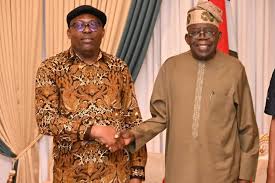
*I’m Leaving A Legacy Behind, Says Ibas
*PDP Youth Leader Urges Tinubu To Apologise For ‘Rivers Overreach,’ Probe Of Ibas
BY GODWIN IJEDIOGOR
PRESIDENT Bola Tinubu has ended the emergency rule he declared in Rivers State six months ago, precisely on March 18, following the political logjam there that was gradually degenerating, especially after the Supreme Court judgment on the crisis.
In a statement released by the Presidency on Wednesday, September 17, Tinubu asked the suspended Governor, Siminalayi Fubara, his Deputy, Ngozi Odu, and members of the state House of Assembly, led by Martins Amaewhule, to resume their duties on Thursday, September 18.
The President, in the statement, said: “My Fellow countrymen and, in particular, the good people of Rivers State. I am happy to address you today on the state of emergency declaration in Rivers State.
“You will recall that on 18th March, 2025, I proclaimed a state of emergency in the state. In my proclamation address, I highlighted the reasons for the declaration.
“The summary of it for context is that there was a total paralysis of governance in Rivers State, which had led to the Governor of Rivers State and the House of Assembly being unable to work together. Critical economic assets of the State, including oil pipelines, were being vandalised.
“The State House of Assembly was crisis-ridden, such that members of the House were divided into two groups. Four members worked with the Governor, while 27 members opposed the Governor. The latter group supported the Speaker.
“As a result, the Governor could not present any Appropriation Bill to the House, to enable him to access funds to run Rivers State’s affairs. That serious constitutional impasse brought governance in the State to a standstill.
“Even the Supreme Court, in one of its judgments in a series of cases filed by the Executive and the Legislative arms of Rivers State against each other, held that there was no government in Rivers State.
“My intervention and that of other well-meaning Nigerians to resolve the conflict proved abortive as both sides stuck rigidly to their positions to the detriment of peace and development of the State.
“It, therefore, became painfully inevitable that to arrest the drift towards anarchy in Rivers State, I was obligated to invoke the powers conferred on me by Section 305 of the 1999 Constitution, as amended, to proclaim the state of emergency.
“The Offices of the Governor, Deputy Governor, and elected members of the State House of Assembly were suspended for six months in the first instance. The six months expire today, September 17th, 2025.
“I thank the National Assembly, which, after critically evaluating the justification for the proclamation, took steps immediately, as required by the Constitution, to approve the declaration in the interest of peace and order in Rivers State.
“I also thank our traditional rulers and the good people of Rivers State for their support from the date of the declaration of the state of emergency until now.
“I am not unaware that there were a few voices of dissent against the proclamation, which led to their instituting over 40 cases in the courts in Abuja, Port Harcourt, and Yenagoa, to invalidate the declaration. That is the way it should be in a democratic setting. Some cases are still pending in the courts as of today.
“But what needs to be said is that the power to declare a state of emergency is an inbuilt constitutional tool to address situations of actual or threatened breakdown of public order and public safety, which require extraordinary measures to return the State to peace, order and security.
“Considered objectively, we had reached that situation of total breakdown of public order and public safety in Rivers State, as shown in the judgment of the Supreme Court on the disputes between the Executive and the Legislative arm of Rivers State.
“It would have been a colossal failure on my part as President not to have made that proclamation.”
HGe added: “As a stakeholder in democratic governance, I believe that the need for a harmonious existence and relationship between the executive and the legislature is key to a successful government, whether at the state or national level. The people who voted us into power expect to reap the fruits of democracy.
“However, that expectation will remain unrealisable in an atmosphere of violence, anarchy, and insecurity borne by misguided political activism and Machiavellian manipulations among the stakeholders.
“I am happy today that, from the intelligence available to me, there is a groundswell of a new spirit of understanding, a robust readiness, and potent enthusiasm on the part of all the stakeholders in Rivers State for an immediate return to democratic governance.
“This is undoubtedly a welcome development for me and a remarkable achievement for us. I therefore do not see why the state of emergency should exist a day longer than the six months I had pronounced at the beginning of it.
“It, therefore, gives me great pleasure to declare that the emergency in Rivers State of Nigeria shall end with effect from midnight today.
“The Governor, His Excellency Siminalayi Fubara, the deputy governor, Her Excellency Ngozi Nma Odu, and members of the Rivers State House of Assembly and the speaker, Martins Amaewhule, will resume work in their offices from 18 September 2025.
“I take this opportunity to remind the Governors and the Houses of Assembly of all the States of our country to continue to appreciate that it is only in an atmosphere of peace, order, and good government that we can deliver the dividends of democracy to our people. I implore all of you to let this realisation drive your actions at all times.”
Before the President’s announcement, tension has risen earlier in the morning at the Government House, Port Harcourt, when aides of outgoing Sole Administrator, Vice Admiral Ibok-Ete Ibas (rtd), protested over unpaid allowances and entitlements.
The visibly angryaides, reportedly accused Ibas of attempting to vacate office without paying their entitlements.
Some of his political and security aides lamenting that he was “sneaking away” with the state’s resources, forcing senior officials at the Government House to step in to appease them with assurances that their grievances would be addressed.
And after minutes of persuasion, the aggrieved staff dispersed, though still bemoaning their fate.
Recall that Ibas, a former chief of Naval staff, was appointed by Tinubu at the peak of the political crisis between Fubara and predecessor and enstranged political godfather, Federal Capital Territory (FCT) Minister, Nyesom Wike, to save the situation from escalating.
There have been interventions and reconciliation meetings by the President with the warring parties to seek an end to the situation.
However, Ibas, at the launch of the International Public Sector Accounting Standard (IPSAS) and new revenue codes for the state, enthused that his administration was leaving behind a legacy of transparency, discipline and reform.
Speaking at th unveiling at Government House to mark the conclusion of fiscal reforms designed to align the state’s financial management with international best practices, Ibas said the initiative was introduced to tackle weaknesses in the state’s revenue system, which he stated had suffered from leakages and imprecise computation.
Saying “this reform ushers in transparency, accountability and efficiency. Every transaction will be traceable, every payment verifiable and every process auditable in real time,” the former sole administrator explained that the combined implementation of IPSAS and the modernised revenue codes would strengthen the credibility of the state’s financial records, boost investor confidence and attract international development partners.
He said the measures would also broaden the tax net and increase Internally Generated Revenue (IGR), adding: “Though my time here is short, the legacy we leave behind is one of courage, discipline, and reform. History will judge that every action was taken for the general good of Rivers State.”
Meanwhile, the Peoples Democratic Party (PDP) has asked the President to apologise to Nigerians, saying he went beyond his constitutional powers by suspending Fubara and others during the emergency rule period.
Its Deputy National Youth Leader, Timothy Osadolor, told Vanguard on Wednesday, September 17, in Abuja, that Tinubu’s action undermined the separation of powers and set a dangerous precedent for Nigeria’s democracy.
He stated: “I think the President was overreaching. When I read the last paragraph of his speech, where he spoke to governors as if he were a headmaster in a classroom, I felt he should understand fully well that there is a clear division of powers.”
The PDP youth leader said if the President could assume the power to suspend elected governors, then no effective check would exist on presidential authority, adding that such overreach was a direct violation of the 1999 Constitution (as amended).
According to him: “If he has the powers to remove elected governors, who now has the powers to check the President, who was also elected?
“First and foremost, I would have expected the President to apologise not only to Nigerians, but also to the wider public.”
He urged the President to encourage the National Assembly to legislate against any repeat of what he termed an “arrogant suspension of a governor,” accusing the federal lawmakers of being compromised to endorse an unconstitutional process.
Osadolor stated: “He did what he did before sending messages to the National Assembly, who allegedly were induced financially to ratify an abnormally ill report.
“For me, we must encourage stronger institutions and more respect for the Constitution of the land.” While insisting that Nigeria is governed by rules and regulations, he cautioned that no President, however powerful or motivated, has the right to violate the nation’s Constitution.
“No President, no matter how powerful or how emotionally challenged or motivated he may be, should use the authority of his office to rip apart the Constitution of the Federal Republic of Nigeria.
“The last paragraph, where he spoke to these governors and their stakeholders as if he were a military commander, is uncalled for. He should learn to respect offices and recognise that elimination of powers is a threat to the Constitution.”
He called for a thorough probe of the “six-month aberration of an occupational government involving Universal People,’ saying it exposed weaknesses in Nigeria’s governance system, insisting: “There is no provision that empowers the President to suspend a governor before going to the National Assembly.
“It is the National Assembly alone that has that responsibility.”


