

THE United States (US) has urged the Nigerian government to take bold and decisive actions to protect Christian communities, following the recent attacks on churches in Kaduna State and abduction of over 170 worshippers.
The US Under Secretary for Political Affairs, Allison Hooker, speaking during a high-level US-Nigeria working group meeting in Abuja on Thursday, January 22, said the parley was to discuss how both countries could work together to deter violence against Christian communities, prioritise counter-terrorism and insecurity, investigate attacks and hold perpetrators accountable, as well as reduce the number of killings, forced displacements and abductions of Christians, particularly in the North Central zone.
She acknowledged that some progress had been made in recent months, but stated that recent attacks showed that Nigeria must do more to guarantee the safety of Christians and their right to practise their faith freely.
According to her: “On the protection of Christians, the Nigerian government recently secured the release of 38 Christians abducted from a church in Kwara State, and another 265 abducted from St. Mary’s Catholic School.
“This real progress is a direct result of our engagement with the Nigerian government.
“However, we are concerned about recent reports that gunmen kidnapped more than 170 Christians in Kaduna State on January 18.
“The Government of Nigeria must do more to protect Christians and their right to practise their faith freely and safely.”
She added: “Advancing religious freedom and security will help the United States and Nigeria enhance the reciprocal benefits of our relationship, solidifying trade and economic deals, degrading terrorist groups that threaten our interests and strengthening health responses, among many other areas.
“We hope to identify ways to return internally displaced persons to the communities from which they were expelled in the north-central states, interdict weapons and funding going to terrorist groups, expand investigations and ensure the prosecution of individuals and groups committing atrocities.”
In his response, National Security Adviser (NSA) to President Bola Tinubu, Nuhu Ribadu, acknowledged the weight of the security challenges, but assured that government was intensifying military and law enforcement operations in affected areas and attacks based on religious lines were unacceptable and would be met with force and justice.
He added: “Nigeria is a deeply plural society, and the protection of all citizens, Christians, Muslims and those of other beliefs, is non-negotiable. Violence framed along religious lines is treated as an attack on the Nigerian state itself.
“Our response, therefore, integrates security operations, the rule of law, humanitarian safeguards and strategic communication, ensuring that operational successes translate into public confidence and strengthened social cohesion.
“At the national level, and under the leadership of President Bola Tinubu, Nigeria has taken deliberate and decisive steps to confront insecurity.
“The President has formally declared national security emergencies in vulnerable and high-risk areas, authorised intensified joint operations and directed the sustained deployment of security forces to priority locations, particularly communities experiencing recurrent attacks on civilians and religious groups.
“These directives have been matched with concrete action. Nigeria is expanding early-warning and rapid-response mechanisms and developing a national database to serve as a single, authoritative source of accurate and verifiable data on deaths and casualties arising from violence.
“This effort will strengthen evidence-based decision-making, accountability and the effectiveness of security responses.
“In parallel, investigations and prosecutions related to attacks on religious communities have been intensified to ensure that violence is met not only with force, but also with justice and accountability.”
Recall that on October 31, last year, US President, Donald Trump, re-designated Nigeria a Country of Particular Concern (CPC), following allegations of a Christian genocide in Nigeria, which the government had denied.
The following month, Trump threatened to go into Nigeria “guns-a-blazing to wipe out the terrorists killing our Christians,” and on Christmas Day, December 25, the US launched air strikes against two terrorist enclaves in Bauni Forest in Tangaza Local Council of Sokoto state.
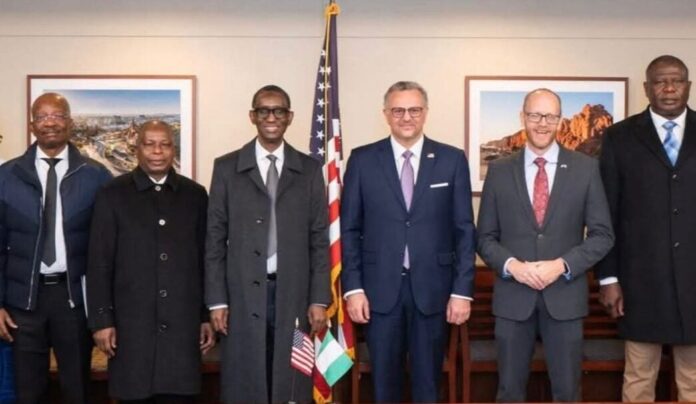
Ribadu led the Nigerian delegation, comprising 10 ministries and agencies, while Hooker headed the US team of eight federal agencies at the meeting.
A statement issued by the US Mission after the meeting said the objectives were to reduce violence against vulnerable groups in Nigeria, particularly Christians, and to create a conducive atmosphere for all Nigerians to freely practise their faith.
According to the Mission: “Strategic discussions at the session focused on a wide range of issues and challenges where US-Nigeria cooperation will improve religious freedom and bolster security across the country.
“The US side welcomed an overview of Nigeria’s realignment of resources to address insecurity, particularly in the North Central states.
“The two governments reiterated their strong and unflinching commitment to upholding the principles of religious freedom and the need, therefore, to take joint active, sustained measures to promote and protect the rights to freedom of expression, peaceful assembly and freedom of religion or belief for all, in line with the Constitution of the Federal Republic of Nigeria.”
The Mission said both sides committed to further strengthening counter-terrorism cooperation, including by working together through operational cooperation, access to technology, anti-money laundering, countering the financing of terrorism and building law enforcement and investigative capacity.
Published:

Related articles

Recent articles
