

FOLLOWING the burial of Pope Francis on Saturday, April 26 in the Papal Basilica of St Mary Major, the first Pope in over 120 Pope’s burial place a powerful symbol of papacy, the race to succeed him has started.
Francis’ decision to be buried in the Papal Basilica of Saint Mary Major is “surprising… but not novel,” according to historian, Donald Prudlo, who in this interview reflects on the significance of papal burial places.
According to Vatican News’ Christopher Wells, Francis became the first Pope in over 120 years to be buried outside the precincts of St. Peter’s Basilica.
“But over the course of 266 pontiffs, there have been numerous burial places,” said Prudlo, Warren Professor of Catholic Studies at the University of Tulsa.
“When a Catholic thinks about the death of the Pope, they tend to gravitate to St. Peter’s,” he told Vatican News, adding: “And it’s true that more than half of the popes in the Church’s history are laid to rest within Saint Peter’s,” dating back to the original church structure built by Constantine, the first Christian emperor.
But if Pope Francis’ choice to be buried outside St. Peter’s, and what is now Vatican City, “is surprising… it is certainly not novel,” Prudlo said.
Wells recalled that in the past 200 years, two Popes- Pius IX, in the wake of the Italian Risorgimento, and a Dominican, Leo XIII, and Sixtus V, his mmediate successor and a Franciscan- found their final resting places in Roman churches, St. Lawrence Outside the Walls and St. John Lateran, respectively.
And over the centuries, various Popes were laid to rest in different Italian cities, in France (during the period Popes resided at Avignon), and even as far away as Germany and Ukraine.
Prudlo noted that Francis is the eighth Roman Pontiff whose final resting place lies within the walls of the Papal Basilica of Saint Mary Major, noting: “There were some from the Middle Ages, Honorius III and Nicholas IV, before it became “a particular place of papal burial in the 16th century.
“So, in a lot of ways, it’s a place particularly friendly to the religious orders.”
However, the largest and oldest church in Rome dedicated to the Blessed Virgin Mary, he stated, is also marked by a special Marian devotion,” the devotion, so loved and valued by Francis and the Roman people, to the Icon of Mary, under the title of “Salus Populi Romani.”
Francis’ has been interred in a niche directly adjacent to the chapel housing the icon.
Images of his tomb at the Santa Maria Maggiore church in Rome released, showed a single white rose pictured lying on the stone tomb that bears the name he was known by during his pontificate, below a crucifix illuminated by a single spotlight.
The late pope was laid to rest at the church, one of four major basilicas in the Italian capital, and one he would regularly visit during his time as cardinal and pontiff, in a private ceremony, following his public funeral in the Vatican on Saturday.
Mourners queued outside the church early on Sunday morning, April 27, to be among the first to pay their respects to Francis, who died aged 88 on Monday, April 21.
Francis was particularly devoted to the Virgin Mary, and Santa Maria Maggiore was the first church to be dedicated to her when it was built in the 4th Century.
The basilica sits near the Colosseum, a stone’s throw from the city’s endlessly bustling and chaotic central Termini station, well beyond the limits of the Vatican, where popes are traditionally entombed.
But it was one the South American pontiff had a long-held affinity for. It’s senior priest previously told an Italian newspaper that Francis had said he wished to be laid to rest there in 2022, citing inspiration from the Virgin Mary.
Francis’ funeral was attended by heads of state, heads of government and monarchs from around the world, as well as hundreds of thousands of Catholics, who lined the streets leading to the Vatican to pay their respects.
Hymns played out on giant speakers, occasionally drowned out by the sound of helicopters flying overhead, before 91-year-old Cardinal Giovanni Battista Re gave a homily on the pope’s legacy.
The cardinal recalled that Francis had repeatedly urged the world to “build bridges, not walls.”
The funeral was also the venue for a meeting between US President, Donald Trump, and Ukraine’s Volodymyr Zelensky, which the latter said afterwards had the “potential to become historic.”
Trump later questioned Russian President Vladimir Putin’s willingness to end the now three-year war in Ukraine, a conflict which Francis had regularly called for peace during his papacy.
Following the public funeral, Francis’ coffin was carried through Rome in a slow procession. Authorities said 140,000 people had lined the streets, clapping and waving as the hearse, a repurposed white popemobile, crossed the Tiber River and drove past some of Rome’s most recognisable sights, such as the Colosseum, the Forum and the Altare della Patria national monument on Piazza Venezia.
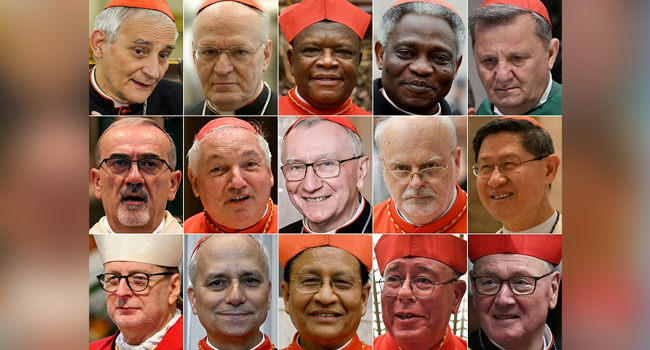
After a period of mourning, attention now shifts to the selection of the next pope. A date has not yet been set, but it is thought it could start as early as 5 or 6 May, with 135 cardinals set to attend, making it the largest conclave in modern history.
“The place of interment can be a symbol of the papacy. This particular choice by pFrancis is a very powerful one.
It reassociates the Catholic Church with devotion to the Virgin Mary. It shows his closeness to the Roman people in his devotion to the Salus Populi Romani icon. And it reinforces the idea that it is not necessary that the popes should be buried at Saint Peter’s.”
At the same time, Prudlo added, the decision of so many previous popes to be buried in the Basilica dedicated to the first Pope, a “depositio ad Sanctus, being buried near the bones of Saint Peter himself, is also a very strong statement, a statement of the unity and perpetuity of the Petrine line.”
Published:

Related articles

Recent articles
