
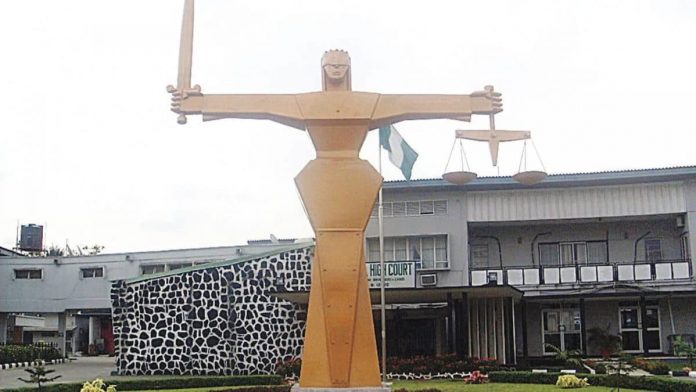
*Orders Speedy Trial
*Falana: Why Lawyers Can’t Be Robed Before Military Courts
JOURNALISTS have been barred from covering the trial of six alleged coup plotters accused of planning to overthrow the government of President Bola Tinubu.
Although the case was not declared a secret trial, concerns have been raised as to its transparency in handling the matter, especially as Judiciary Correspondents were on Monday, April 27, remained in the dark regarding developments in the case, even as the suspects’ bail application is pending before the court.
Court officials, backed by Department of State Services (DSS) operatives, directed reporters to vacate the courtroom shortly before the trial Judge took her seat.
A court official told journalists that the directive came from the Judge, while a DSS operative promised to offer an explanation later.
The journalists, some of whom had arrived at the court premises as early as 8am, complied with the directive and left the courtroom shortly after the Judge was seated about 9:07am.
The six accused persons, who were on Wednesday last week arraigned before Justice Joyce Abdulmalik of the Federal High Court, Abuja, by the Federal Government, led by the Attorney General of the Federation and Minister of Justice, Lateef Fagbemi, were brought into the courtroom under heightened security presence.
All except a former minister of State for Petroleum Resources, Timiprye Sylva, said to be at large, were present in court, including Maj-Gen. Ibrahim Gana (rtd), who was brought in a wheelchair; Navy Captain Erasmus Victor (rtd); Police Inspector Ahmed Ibrahim; Zekeri Umoru, an electrician at the Presidential Villa; Bukar Goni; and Abdulkadir Sani, a Zaria-based Islamic cleric, pleaded not guilty to the 13-count charge when it was read to them.
Consequently, Fagbemi asked that they be remanded in the custody of the DSS and for an expeditious trial.
Justice Abdulmalik granted both request and adjourned the case until April 29 and 30, May 4 and 5, for the commencement of trial and hearing of bail applications.
The charge, filed by the Office of the Attorney General of the Federation and signed by the Director of Public Prosecutions (DPP), Rotimi Oyedepo (SAN), accused the defendants of alleged treason and terrorism, failure to disclose security intelligence and money laundering linked to terrorism financing, among others.
They were alleged to have conspired last year “to levy war against the state to overpower the President of the Federal Republic of Nigeria,” an offence punishable under Section 37(2) of the Criminal Code.
They were also alleged to have prior knowledge of a planned treasonable act involving one Col. Mohammed Alhassan Ma’aji and others, but failed to alert authorities.
According to the statement, Fagbemi had earlier informed the court that the prosecution had witnesses ready, subject to its convenience, while Counsel for the first defendant, Mohammed Ilayepo, told the court that his client’s bail application was due for hearing.
Justice Abdulmalik ruled that the trial would commence before any bail applications are considered.
Counsel to the second, third and sixth defendants- Paul Erokoro, A.I. Yeru and N.S. Diri- expressed reservations about proceeding, citing short notice and the complexity of the case.
The Judge subsequently directed all parties to agree on dates suitable for a speedy trial before fixing the adjourned dates.
At least 40 suspects, including serving and retired military personnel and civilians, were arrested in connection with the alleged plot, but 36 serving officers were arraigned before a court-martial at the Guards Brigade Scorpion Mess in Asokoro, Abuja.
Meanwhile, human rights lawyer, Femi Falana (SAN), has faulted the mode of dressing for the prosecutors and defence counsel that would appear before the general court martial.
Citing the Rules of Professional Conduct for Legal Practitioners in Nigeria, Falana said they are at variance with the Rules of Professional Conduct for Legal Practitioners 2023.
He stated: “Notwithstanding our strident opposition to the setting up of a military court to try the alleged coup plotters, the military authorities have been allowed to convene a General Court Martial for the trial of the 36 military officers accused of attempting to overthrow President Bola Tinubu.
“However, in the Convening Order issued on April 23, 2026, Major General A.M. Alechenu has prescribed a mode of dress for the prosecutors and defence counsel who are going to appear before the General Court Martial.
“Specifically, Item 9 (g) of the Convening Order states that, ‘All officers are to wear No 4 dress (or equivalent), while soldiers are to wear No 5 dress (or equivalent), throughout the duration of the court. All civil lawyers are to be robed. However, serving officers who are lawyers have the option of either wearing No 4 (or equivalent) or being robed.’
“In view of the fact that the directive is completely at variance with the Rules of Professional Conduct for Legal Practitioners 2023, the military authorities should jettison it. Since our position may be ignored by the military authorities, it is necessary to draw the attention of the legal practitioners, including military prosecutors who are going to appear before the General Court Martial, to Rules 8(5) and 45 of the Rules of Professional Conduct for Legal Practitioners, which stipulate as follows: Rule 8(5): ‘An officer in the Armed Forces who is a lawyer may discharge any duties devolving on him as such officer and may appear at a Court Martial as long as he does so in his capacity as an officer and not as a lawyer.
“Rule 45(2): ‘A lawyer shall not wear the Barrister’s or Senior Advocate’s robe (a) on any occasion other than in Court, except as may be directed or permitted by the Bar Council.
“In view of the clear and unambiguous provisions of the Rules of Professional Conduct for Legal Practitioners in Nigeria, defence Counsel and military prosecutors who may be robed before the General Court Martial stand the risk of being dragged before the Legal Practitioners Disciplinary Committee for professional misconduct.”


