
*Mixture of Manual, Electronic Transmission Will Cause Confusion, Says Atiku
*‘Real time’ Doesn’t Guarantee Transparent Poll, Dickson Clarifies
Kalu: ‘Our Democracy Must Work For Every Nigerian’
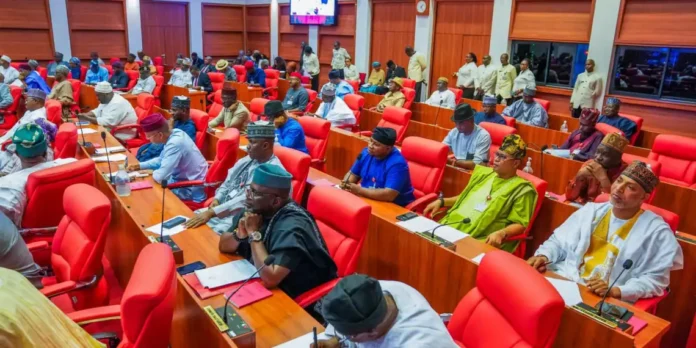
DISSATISFACTION continue to trail the Senate U-turn on Tuesday, February 10, by amending the Electoral Act 2022, to include electronic transmission of election results, but without provision for ‘real time’ or compulsory electronic transmission of the results, insisting the measure does not guarantee transparency and still leaves room for manipulation.
The senate’s volte-face to assuage skeptical Nigerians does not seem to go far enough, as most citizens insisted on mandatory electronic transmission of the results, accusing Senate President, Godswill Akpabio, and the 10th National Assembly of deliberately weakening the country’s electoral process ahead of next year’s general elections.
The Red Chamber had on Tuesday amended the Electoral Act to allow for electronic transmission of election results, but with a condition that allows manual result sheets to prevail where electronic transmission fails.
In a dramatic face-saving move, the Senate passed an amendment to Section 60(3) of the Electoral Act (Repeal and Enactment) Bill, following a motion by its Chief Whip, Mohammed Tahir Monguno, seconded by Senate Minority Leader, Abba Moro.
“Electronic transmission ensures speed, accuracy, and accountability. This is a practical approach that balances innovation with operational realities on the ground,” Monguno said.
Earlier, Enyinnaya Abaribe (Abia South) had called for a division, warning against overturning previously concluded decisions without individual votes.
He later withdrew the motion, clearing the way for the amendment to proceed.
Akpabio, while presiding, stressed that the amendment balances innovation with practical realities on the ground.
The motion was passed by voice vote, with senators reaffirming the chamber’s authority under Orders 1(b) and 52(6) of the Standing Orders to reconsider prior decisions.
Under the revised amendment, presiding officers at polling units are required to electronically transmit results to the Independent national Electoral Commission’s (INEC) Result Viewing Portal (IREV) portal after the completion of voting. But where electronic transmission is unsuccessful due to communication or network failure, the manual result sheet, Form EC8A, shall become the primary basis for collation and declaration of results.
However, critics believed the reliance on Form EC8A as the primary source of election results, where there is communication or network failure, waters down the gains of electoral reforms and goives room for the usual manual manipulation.
Former vice president, Atiku Abubakar, faulted the stance, arguing that having both manual and electronic transmission of results in the Bill will cause further confusion.
Atiku, now a chieftain of the African Democratic Congress (ADC), speaking in Minna, Niger State, said: “Nigerians were expecting real-time electronic transfer to the various levels of the elections. But what we got is a mixture of electronic and manual transmission, which is going to cause more confusion or chaos.
“At this point, this is not about me contesting elections; it is about Nigerians who want electronic transmission of election results.
“If we have a single-tier electoral transmission system that is real-time electronic, that would be our preference, and I think there is a need for all the opposition political parties to come together to pursue this issue.
“ I mean, we shouldn’t allow it to rest where they wanted it to rest today. Absolutely not. I don’t support that.”
Another ADC member, Kenneth Okonkwo, urged the senate to remove the manual clause in the transmission of results, adding: “Once they put that law that you must transmit from the polling unit, I am okay. So, any polling officer would not leave the polling unit.”
Okonkwo, during a television interview, stated: “The House of Representatives should go further to say that where it is not possible to transmit from the polling unit, that election should be cancelled.
“The reason you are doing accreditation, voting is for the result. If you do all these things to get a fraudulent result, what have you gained? You have actually emboldened the criminals.
“The only problem we have in this country is fraudulent elections.”
National Coordinator of the Obidient Movement, Yunusa Tanko, warned that the option could create confusion and undermine the electoral process.
Noting that the situation amounted to “setting the people up,” Tanko urged the lawmakers to either fully support electronic transmission of results or address the infrastructural challenges associated with it, such as poor Internet connectivity in some areas.
He stated tha allowing a return to manual transmission of results where electronic transmission is considered impossible could lead to disputes at polling units and collation centres, as parties may disagree over the existence or absence of network service.
Tanko stated that the Senate’s position was a “chaotic resolution” that could worsen electoral challenges, rather than resolve them, and could generate further tension in future elections.
“They are setting the people up for chaps. What I meant by this is that you either support the electronic transmission of results holistically and provide solutions to inadequacies that may be faced with that particular process. It is a setup for chaos.
“Everybody can say that there is no service in his own area and then there will be an argument between those who want electronic transmission and those who don’t want.
“It’s a chaotic resolution; it won’t help, but rather create more problems. At least, the only thing in that discussion is that they have now learned that the power of the people reign supreme.
“I will rather advise the National Assembly to be really decisive on this matter, rather than to leave it hanging. Today, they are finding it difficult to approve, tomorrow it may turn to hunt them.
“We will continue to advocate for good governance and the process for election. And anything that’s required for us to do, based on the confines of law and order, we will do it. Our people will revert and take a look at the new resolution and take the next step.
“Well, they should wait for the consequence from the people. The action of the people will testify whether they’ve taken the right decision or not. The party, of course, as I said, will revisit it and look at what needs to be done accordingly.”
Amid the criticisms, Senate spokesman, Yemi Adaramodu, stressed that the Red Chamber cannot be intimidated over the real-time transmission of election results, saying it does not play to the gallery.
Speaking on television programme, Adaramodu said: “We are not worried, we’re not to be intimidated, and we shouldn’t be intimidated.
“Moreover, as we know, in Nigeria and anywhere else where democracy is thriving, there will be shades of opinions, there will be shadows of ideas, and then we have to listen to all. So, that’s what happened.”
Seriake Dickson (Bayelsa-PDP), a member of the Committee on Electoral Matters, said the removal of the phrase, “real time,” from the Bill does not weaken the provision for electronic transmission of results or undermine electoral transparency.
Speaking on a television programme, Dickson said the latest decision still makes electronic transmission of results from polling units to the IREV mandatory, adding: “I don’t count the proceedings of today and the outcome as a loss for democracy.
“I’m not here as spokesman of the Senate; I’m here to give my views as someone who has been deeply involved in all these processes as a ranking member of this committee and as someone who participated in the proceedings of today.
“I was not there when the senate took that decision earlier, about a week ago, as I was bereaved… Today was the very first day I went to sit in the senate, because of the importance of this matter.”
The former Bayelsa State governor described the earlier decision as “unfortunate,” given that INEC had assured lawmakers of its capacity to transmit results electronically, even as he argued that the term was being misunderstood.
“What is the meaning of real time? We are not voting electronically in Nigeria. The word ‘real time,’ in this context, is actually superfluous. It doesn’t on its own give you a transparent election.
“The primary evidence of who won an election is the EC8A… INEC compels presiding officers to transmit the result to IREV. That is good enough for us.
“I don’t agree with the proviso that has been included, but parliament works on the basis of majority.”
He stressed that the law still mandates electronic transmission, noting that “the general rule is that every presiding officer shall transmit the result electronically. That is mandatory.
“You make gains incrementally… We have made electronic transfer mandatory, and that is progress.”
His colleague, Orji Uzor Kalu Abia-PDP), in a statement, said: “Today at the emergency plenary, I supported and added my voice to the senate’s new position approving the electronic transmission of election results from polling units across Nigeria.
“Our democracy must work for every Nigerian, everywhere.”
Meanwhile, the senate has increased its representation on the Conference Committee for the Electoral Bill Amendment 2026 to 12 members, in tandem with the number from the House of Representatives, to facilitate smooth negotiations and harmonisation of differences between both chambers before the Bill’s final passage.
The committee is chaired by Simon Lalong, with Munguno, Aliero Adamu Muhammad, Kalu, Moro, Asuquo Ekpenyong, Abas Aminuia, Abiru Adetukumbo, Adeniyi Adegbomire, Jibril Isa Echocho and Banigo Iparibo Harry as members.
Akpabio stressed the urgency of the matter, charging the committee to conclude deliberations within the next few days to a week, for transmission to the President for his assent within February.
“This is a matter of urgency. If the committee concludes its work quickly, the President should be able to sign the amended Electoral Bill into law this month,” he said.


