
*Walkie–Talkies Explode In Latest Attack
*Hezbollah Rattled By Blasts
*20 Killed And Over 450 Injured, Lebanon Health Ministry Says
*Israel’s Mossad Has Long History Of Sophisticated Attacks
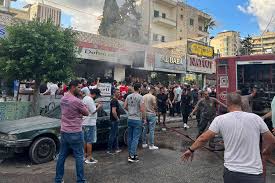
IN a further escalation of the conflict between Israel and Islamic armed group, Hezbollah, hand-held radios used by the group detonated on Wednesday, September 18, across Lebanon’s south in the country’s deadliest day since cross-border fighting erupted between the militants and Israel nearly a year ago, stoking tensions after similar explosions of the group’s pagers the day before.
Lebanon’s health ministry said 20 people were killed and more than 450 injured on Wednesday in Beirut’s suburbs and the Bekaa Valley, while the death toll from Tuesday’s explosions rose to 14, including two children, with nearly 3,000 injured.
Israeli officials have not commented on the blasts, but security sources said Israel’s spy agency, Mossad, was responsible.
One Hezbollah official said the episode was the biggest security breach in the group’s history.
The operations, which appeared to throw Hezbollah into disarray, played out alongside Israel’s 11-month-old war in Gaza and heightened fears of an escalation on its Lebanese border and the risk of a full-blown regional war.
“We are opening a new phase in the war. It requires courage, determination and perseverance from us,” Israeli Defence Minister, Yoav Gallant, said in remarks at an Air Force base.
Jordan’s Foreign Minister, Ayman Safadi, accused Israel of pushing the Middle East to the brink of a regional war by orchestrating a dangerous escalation on many fronts.
The United States (US), which denied any involvement in the blasts, said it was pursuing intensive diplomacy to avert an escalation of the conflict.
A US official, speaking on condition of anonymity, said Israel told Washington on Tuesday it was going to do something in Lebanon, but did not provide details and the operation itself was a surprise to Washington.
At least one of Wednesday’s blasts in Lebanon took place near a funeral organised by Iran-backed Hezbollah for those killed the previous day when thousands of the group’s pagers exploded across the country and wounded many of its fighters.
A Reuters reporter in the southern suburbs of Beirut said he saw Hezbollah members frantically taking batteries out of any walkie-talkies that had not exploded, tossing the parts in metal barrels.
Hezbollah turned to pagers and other low-tech communication devices in a bid to evade Israeli surveillance of mobile phones.
Lebanon’s Red Cross said on its X handle that it responded with 30 ambulance teams to multiple explosions in different areas, including the south of Lebanon and the Bekaa Valley.
Images of the exploded walkie-talkies showed labels bearing the name of Japanese radio communications and telephone company, ICOM, and resembled the firm’s model, IC-V82 device.
Tokyo Stock Exchange-listed ICOM said on Thursday it was investigating news reports two-way radio devices bearing its logo exploded in Lebanon and would release updated information as it becomes available on its website.
The company, which said it manufactures all of its radios in Japan, could not confirm whether it had shipped the device, in part because that model had been discontinued 10 years ago.
The Osaka-based firm said its products for overseas markets are sold exclusively through authorised distributors and it vets exports in accordance with Japan’s security trade control regulations.
The company has previously warned about counterfeit versions of its devices circulating in the market, especially discontinued models.
The hand-held radios were purchased by Hezbollah five months ago, around the same time as the pagers, a security source said.
In Tuesday’s explosions, sources said Israeli spies remotely detonated explosives they planted in a Hezbollah order of 5,000 pagers before they entered the country.
The United Nations (UN) Security Council would meet on Friday about the pager blasts after a request by Arab states.
Tehran’s ambassador in Lebanon was superficially injured in Tuesday’s blasts, Iran’s semi-official Fars news agency reported then.
But the New York Times on Wednesday said he lost one eye and the other was severely injured when a pager he was carrying exploded, citing two members of Iran’s Revolutionary Guard (IRG).
Iran’s envoy to the UN said in a letter on Wednesday that it “reserves its rights under international law to take required measures deemed necessary to respond” to the attack.
Hezbollah, which has vowed to retaliate against Israel, said on Wednesday it attacked Israeli artillery positions with rockets, the first strike at its arch-foe since the blasts.
The Israeli military said there were no reports of any damage or casualties.
“Hezbollah wants to avoid an all-out war,” said Mohanad Hage Ali, Deputy Director of Research at the Carnegie Middle East Center in Beirut, adding: “But given the scale … there will be pressure for a stronger response.”
The two sides have been fighting across the Lebanese border since the Gaza conflict erupted on October 7, last year, fuelling fears of a wider Middle East war that could drag in the US and Iran.
The previous highest daily Lebanese death toll was 11, who died in Israeli shelling last month, according to official counts.
Gallant said Israel, which has vowed to return evacuated residents to their homes in the north, was transferring troops and resources to the Lebanon border region.
Israeli sources said this included the Army’s 98th Division, which has commando and paratrooper formations, moving from Gaza to the north.
“The ‘centre of gravity’ is moving north, meaning that we are allocating forces, resources and energy for the northern arena,” Gallant said in remarks released by his office.
A full-blown war with Israel could devastate Lebanon, which has lurched from one crisis to another, including a 2019 financial collapse and the 2020 Beirut port blast.
Rising tensions may also complicate so far unsuccessful efforts by mediators- Egypt, Qatar and the US- to negotiate a Gaza ceasefire between Israel and militant group Hamas, a Hezbollah ally, also backed by Iran.
White House National Security spokesperson, John Kirby, said on Wednesday it was too soon to assess the impact of the blasts on ceasefire talks.
Hezbollah, Iran’s most powerful proxy in the Middle East, said in a statement it would continue to support Hamas in Gaza and Israel should await a response to the pager “massacre.”
A Hamas delegation visited people wounded in the blasts in Lebanese hospitals on Wednesday, Lebanese state news agency NNA said.
The explosions followed a series of assassinations of Hezbollah and Hamas commanders and leaders ascribed to Israel since the start of the Gaza war.
The pager attack puts spotlight on Israel’s cyber warfare Unit 8200, the Israel Defense Forces’ intelligence unit, which a Western security source said was involved in planning the operation.
Israeli officials have remained silent on the audacious intelligence operation that killed 14 people on Tuesday and wounded thousands of Hezbollah operatives.
At least one person was killed on Wednesday when hand-held radios used by Hezbollah detonated.
A senior Lebanese security source and another source told Reuters that Israel’s Mossad spy agency was responsible for a sophisticated operation to plant a small quantity of explosives inside 5,000 pagers ordered by Hezbollah.
One Western security source told Reuters that Unit 8200, a military unit that is not part of the spy agency, was involved in the development stage of the operation against Hezbollah, which was over a year in the making.
The source said Unit 8200 was involved in the technical side of testing how they could insert explosive material within the manufacturing process.
The Israeli military declined to comment and the prime minister’s office with an oversight function on Mossad did not immediately respond to a request for comment.
Yossi Kuperwasser, a former military intelligence official and now Research Director at the Israel Defense and Security Forum, said there was no confirmation that the military intelligence unit was involved in the attack.
But he said 8200’s members were some of the best and brightest personnel in the Israeli military, serving in a unit at the centre of Israel’s defence capabilities, adding: “The challenges they are facing are immense, very demanding, and we need the best people to get involved in that.”
The unit – and its legion of young, hand-picked soldiers – develops and operates intelligence-gathering tools and is often likened to the US National Security Agency.
In a rare public statement about the unit’s activities, the IDF said in 2018 that it had helped to thwart an air attack by Islamic State on a Western country.
At the time, it said the unit’s operations ran from intelligence gathering and cyber defence to “technological attacks and strikes.”
While Israel has never confirmed its involvement, Unit 8200 was reported to have been involved in the Stuxnet attack that disabled Iranian nuclear centrifuges, as well as a series of other high profile operations outside Israel.
The unit is effectively Israel’s early warning system, and like much of the rest of the defence and security establishment, shouldered some of the blame for failing to detect Hamas’ October 7 assault on southern Israel.
Its commander, last week said he was stepping down, and in his resignation letter carried by Israeli media, he said he hadn’t fulfilled his mission.
The unit is famous for a work culture that emphasises out-of-the-box thinking to tackle issues previously not encountered or imagined. This helped some graduates build Israel’s high-tech sector and some of its biggest companies.
“Whether it’s a problem with software weakness, math, encryption, a problem hacking into something … you must be capable to do it on your own,” said Avi Shua, a graduate of 8200, who went on to co-found Orca Security, a cloud security unicorn.
The unit has a high turnover rate of young recruits replacing veterans, said Kobi Samboursky, another former 8200 member and Managing Partner at Glilot Capital Partners, an early stage fund investing in cybersecurity and artificial intelligence.
“The most significant thing here is the ‘can-do’ culture, where everything is possible,” Samboursky said.


