
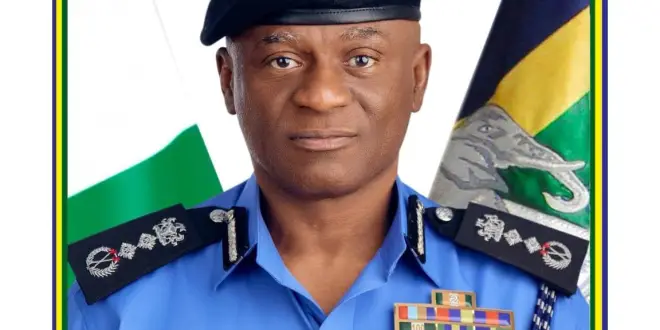
*Pledges Better Welfare For Personnel
THE Inspector General of Police (IGP), Tunji Disu, vowed his support for the establishment of State Police, whose idea he said has come to stay, describing it as an opportunity for partnership, rather than a threat to the Nigeria Police Force (NPF).
This view aligns with President Bola Tinubu’s repeated pledges to decentralise policing in Nigeria as part of a broader push to address the country’s security challenges.
The President recently urged the National Assembly to further amend the 1999 Constitution to create the necessary legal framework for the creation of State Police.
Tinubu had, at a brief ceremony ahead of the Federal Executive Council (FEC) meeting, in Abuja, on Wednesday, March 4, administered the oath of office to Disu.
Speaking after his swearing in as the 23rd IGP,, Disu stated: “State Police has come to stay, and the Police should be able to contribute their part in making it succeed.
“The Police are not afraid; our jobs are not being taken. It is an issue of partnership.”
He had earlier in the day inaugurated a committee to develop an operational framework for the establishment and coordination of State Police structures across the country.
Explaining the rationale for setting up the committee, led by Olu Ogunsakin, a professor of Police Studies, Disu said: “We don’t want it to seem as if others are taking decisions and we, the most important people concerned, did not do anything.”
Meanwhile, the IGP has assured that the welfare of Police personnel remained a top priority of his leadership, noting that improved working conditions, motivation and professionalism were essential to enhancing the effectiveness of the Force.
He vowed that the Police leadership would remain focused on accountability, professionalism and improved service delivery as part of efforts to deepen public trust in law enforcement.
Disu said the NPF was closely monitoring developments in the Middle East and possible effects on Nigeria.
He told journalists after the ceremony that the Police had intensified surveillance and patrols across the country to forestall any breakdown of law and order as a result of the crisis.
Disu said security agencies were aware that some religious groups in the country maintain ideological affiliations with movements in the Middle East; hence the need to remain vigilant whenever tensions escalate in that region, adding: “That is what we call the territory.
“Our ears are on the ground. We know that we have different Islamic sects in Nigeria, and some of them pay allegiance to the eastern part of the world.”
The IGP acknowledged that any significant development in the Middle East could trigger reactions locally; hence the Police were already taking precautionary steps to prevent possible unrest by deploying officers on patrol across strategic locations, while also engaging religious and community leaders to ensure individuals or groups do not resort to violence or take the law into their own hands.
He cautioned Nigerians against spreading unverified information capable of causing panic or undermining public safety, particularly on social media, urging them to verify information before sharing it and to rely on official channels for accurate updates, as such misinformation could create unnecessary fear and complicate the work of security agencies.
The IGP charged the public to support ongoing security operations by providing timely and credible intelligence to the Police and other security agencies, even as he restated the new leadership’s commitment to strengthening intelligence gathering, community engagement and strategic partnerships to sustain peace and stability nationwide.


