
Friends Criticising Me Lobbied For Vice President Slot, Says Tinubu
THE presidential candidate of the All Progressives Congress (APC), Bola Tinubu, has stated that those criticising him over his choice of Senator Kashim Shettima as his running mate had approached him for the position.
He added that most of them were close to him and had indicated interest to become his running mate, an overture he said he bluntly turned down.
His choice of Shettima, a fellow Muslim and former Borno State governor had elicited opposition and criticisms from many Nigerians, including the then leadership of the Christian Association of Nigeria (CAN). Former Secretary to the Government of the Federation (SGF), Babachir Lawal, and former Speaker of the House of Representatives, Yakubu Dogara, among others, have been at the forefront of the criticism of APC’s Muslim-Muslim ticket.
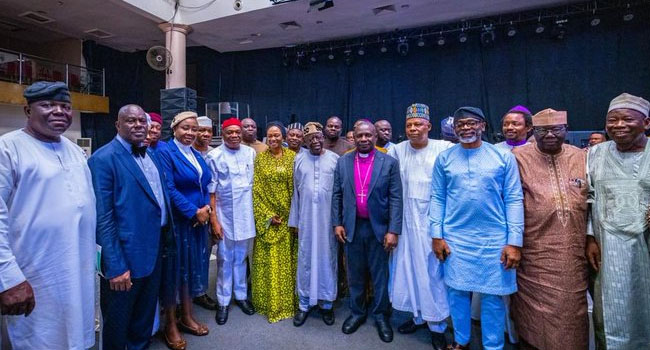
But speaking during an interactive session with the CAN leadership, led by Archbishop Daniel Okoh, at the Ecumenical Centre in Abuja, Tinubu dismissed claims of planned Islamisation of Nigeria, insisting: “People have reacted harshly to my selection. They are because they are my friends, they lobbied me and wanted to be my running mate but I bluntly rejected them.
“The rumour that this is some plot to suppress the Christian community is untrue and unfortunate. I don’t have that kind of agenda. The bucks stop on my table, not on the vice president’s table unless so delegated. He cannot even forgive convicted inmates if I don’t delegate the power to him. What is the vice- president?
“I can no more suppress the Christians of this nation than I can suppress the Christians in my own household, my very family. I dare not contest the presidential position in my house because I will lose, they are all Christians. If I did not Islamise my family, I cannot Islamise Nigeria. It is awful to hear such allegations. We cannot make progress if we continue to follow that path in the country. Religions will not help us. It won’t do any good to us.”
He pointed out that a Christian running mate would have been politically easier, saying that was not his way, just as he added: “Why a Shettima? Why the same faith ticket? These are irrelevant to the well-being of our country. I did not choose him so that we could form the same faith ticket; I chose him because I want a progressive government and people- based ideology ticket.
“I chose him thinking of who will best help me govern than who will best help me worship. Picking a Christian running mate would have been politically easier, but that is not my way. The easy way is rarely the right one. The selection of a running mate is at once a very momentous yet very intimate decision.”
While appealling for the Christian leader’s support, he stated: “We are all here and witnessed Obasanjo and Atiku publicly fighting. We are asking for your votes; think twice, look at our records and the way we have behaved in one office before the other before you take a decision. How best has a Christian and a Muslim President worked for Nigeria? Maybe one of these days we will have a Christian/Christian ticket. The person that I know will help me in the election is the person I have chosen.”
Among other demands, Okoh called for a fully decentralised Police authority, unambiguous religious neutrality of the Nigerian state, enforcement of fundamental rights of all Nigerians, including economic and social rights, as well as equitable and enforceable sharing of executive positions.
He also demanded ethnic and religious representation in the military and other security agencies, self-determination for all Nigerian people, ranching, education and free healthcare for all Nigerians, ban on open grazing and local control of the economy, including waters, rivers, and forests.
The cleric said the constitution failed to provide an order for a society with multiple religious beliefs and practices, stressing that this failure had thrown Nigeria into perennial religious conflicts, adding: “The constitution in Section 10 states that Nigeria and any state in Nigeria will not have a state religion. This provision is reinforced by Section 38 of the 1999 Constitution, which guarantees to every Nigeria the freedom of religion, which includes the right to hold, change and propagate his religion.
“The prohibition against having a state religion is not only that the country or part of it will not make an official declaration that no one else should belong to another religion. No. it is more than that. It includes the government of the federation or the state, acting in any manner that confers one advantage or disability to one religion and not the other.
“This means that when governors of states in northern Nigeria implement a policy of not granting the statutory right of occupancy to churches over landed property, they are violating Sections 10 and 38 of the constitution. It means that when a government spends public money to hire teachers for Islamic schools and not for Christian schools, it violates Section 10 and 38 of the constitution and vice versa. This position was brought out clearly by the Court of Appeal in the case of Adamu v. Bauchi State Government.
“Anyone who soberly considers the actions of the previous and current Nigerian government over religion will realise that those actions proclaim a state religion. It is this flagrant violation of our common citizenship through the co-mingling of religion and politics that is the main cause of religious conflict in Nigeria, terrorism and insecurity.
“We cannot make progress as a nation if we do not behave like other multi-ethnic, multi-religious nation-states that remove religion from politics.”
While stressing the need to separate religion from the state, CAN contended that the next President must ensure a balance between Christians and Muslims, so that the past practice of reckless violation of the rights of one religion or the other will not reoccur, arguing: “We have to be a religiously neutral state, not a religious state. We must have a constitution that is focused on democratic citizenship where the government pays no attention to any private identity apart from citizenship.
“This transition to a modern, democratic, secular state from a neo-feudal, theocratic state requires both constitutional and administrative reforms. It requires that the next Nigerian President carefully constitutes his policy and programme to ensure good balance between Christians and Muslims, so that the past practice of reckless violation of the rights of one religion or the other will not reoccur. That is the minimum requirement of saving Nigeria.”


