
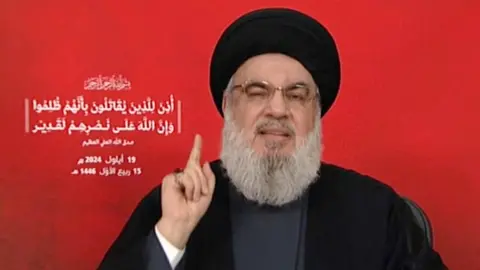
*Group Confirms Death
*Iranian Leader Moved To Safe Location
*No Word On Replacement By Heir Apparent, Safieddine
*Israel Continues Airstrikes On South Beirut
HEZBOLLAH leader, Sayyed Hassan Nasrallah, has been killed in a powerful airstrike in Beirut, Lebanon, dealing a huge blow to the Iran-backed group as it reels from an escalating campaign of Israeli attacks.
The Israeli military said on Saturday it had eliminated Nasrallah in the strike on the group’s central command headquarters in Beirut’s southern suburbs a day earlier.
According to Reuters, his death is not only a major blow to Hezbollah, but also to Iran, removing an influential ally who helped build Hezbollah into the linchpin of Tehran’s constellation of allied groups in the Arab world.
A senior member of Iran’s Revolutionary Guards, Deputy Commander Abbas Nilforoushan, was also killed in Israeli attacks in Beirut, Iranian media reported on Saturday.
Hezbollah confirmed he had been killed, without saying how, only noting in a statement that it would continue its battle against Israel “in support of Gaza and Palestine, and in defence of Lebanon and its steadfast and honourable people”.
The militant group’s Al-Manar TV aired Koran verses after his death was announced. Bursts of gunfire were heard in Beirut.
Friday’s airstrike, a succession of massively powerful blasts that left a crater at least 20 metres (65 feet) deep, shook Beirut.
Israel carried out further airstrikes on the area and more widely in Lebanon on Saturday, with the military saying earlier that Nasrallah was eliminated in a “targeted strike” on the group’s underground headquarters beneath a residential building in Dahiyeh, a Hezbollah-controlled southern suburb of Beirut.
It added that he was killed along with another top Hezbollah leader, Ali Karaki, and other commanders, noting: “The strike was conducted while Hezbollah’s senior chain of command were operating from the headquarters and advancing terrorist activities against the citizens of the State of Israel.”
Nasrallah’s death is by far the most significant blow in a devastating fortnight for Hezbollah, starting with a deadly attack on thousands of wireless communications devices used by its members.
Israel also significantly ramped up airstrikes in Lebanon, killing several top Hezbollah commanders and hundreds of other people across wide areas of the country.
Palestinian militant group, Hamas, while mourning Nasrallah on Saturday, said in a statement that his death would only fuel the fight against Israel.
It added: “Crimes and assassination by the occupation will only increase the determination and the insistence of the resistance in Palestine and Lebanon to go forward with all their might, bravery and pride on the footsteps of the martyrs…and pursue the path of resistance until victory and the dismissal of the occupation.”
Nasrallah’s death marks a heavy blow to Hezbollah as it reels from an escalating campaign of Israeli attacks. It is also a huge blow to Iran, given the major role he has played in the Tehran-backed regional “Axis of Resistance,” which refers to groups, including Hezbollah, that are backed by Iran and have been waging attacks on Israel since war erupted between their ally Hamas and Israel on October 7, last year.
“We reaffirm our absolute solidarity and standing with the brothers in Hezbollah and the Islamic Resistance in Lebanon, who are taking part in the battle of the Al-Aqsa Flood to defend Al-Aqsa mosque, alongside our people and our resistance,” Hamas added.
Islamic Jihad, another Iranian-backed Palestinian group, said in a statement: “Sooner or later, the resistance forces in Lebanon, Palestine and the region will make the enemy pay the price of its crimes and taste defeat for what its sinful hands have done.”
Israel and Hamas have been fighting since gunmen from the Palestinian militant group stormed into southern Israel on October 7, killing 1,200 people and capturing some 250 hostages, according to Israeli tallies.
Gaza has a population of 2.3 million people, most of whom have been internally displaced by the war, which has killed 41,500 of them, according to Gaza health authorities.
Asked how Nasrallah’s death would affect the fight against Israel, senior Hamas official, Sami Abu Zuhri, told Reuters: “The assassination of Nasrallah will not break the will of the resistance and we are confident that the occupation will lose the battle.”
Friday’s attacks on Dahiyeh were followed by more strikes on the area and other areas of Lebanon on Saturday. Huge explosions lit up the night sky and more strikes hit the area in the morning, with smoke rising over the city.
Hezbollah, meanwhile, continued its cross-border rocket fire on Saturday, setting off sirens and sending residents running for shelter deep inside Israel.
Israeli missile defences blocked some of them and there was no immediate report of injuries.
The escalation has increased fears the conflict could spin out of control, potentially drawing in Iran, Hezbollah’s principal backer, as well as the United States (US).
Israeli Defence Minister, Yoav Gallant, said Israel’s war was not with the Lebanese people, calling Nasrallah the “murderer of thousands of Israelis and foreign citizens.
“To the people of Lebanon, I say, our war is not with you; it’s time for change.”
Hezbollah has been waging hostilities with Israel since the eruption of the Gaza war a year ago, when it opened fire, declaring solidarity with its Palestinian ally, Hamas. It has said it would only cease fire when Israel’s Gaza offensive ends.
Israel explained that it has been attacking Hezbollah with the aim of allowing tens of thousands of residents evacuated from northern Israel to return home. In Lebanon, well over 200,000 people have been displaced, around half of them since Monday.
Lebanon’s Transport and Public Works Ministry asked an Iranian plane not to enter Lebanese airspace after Israel warned air traffic control at the Beirut airport on Friday that it would use “force” if it landed, a source at the ministry told Reuters.
The source said it was not clear what was on the plane, adding: “The priority is people.”
Late on Friday, Israeli military spokesperson, Rear Admiral Daniel Hagari, said Israeli Air Force planes were “patrolling the area of the Beirut airport” and would not allow “hostile flights with weapons to land” there, stressing: “We know about Iranian arms transfers to Hezbollah and are thwarting them.”
Iran Air has cancelled all flights to Beirut until further notice, the airline’s spokesman told local media on Saturday.
Hezbollah has fired hundreds of rockets and missiles at targets in Israel, including Tel Aviv and the Israeli military said the country was on high alert for a broader conflict.
“It’s safe to assume that they are going to continue carrying out their attacks against us or try to,” Lt-Col. Nadav Shoshani said in a media briefing.
“We are facing a great battle,” Nasrallah said in an August 1 speech at the funeral of Hezbollah’s top military commander, Fuad Shukr, who was killed in an Israeli strike on the Hezbollah-controlled southern suburbs of Beirut.
Yet, when thousands of Hezbollah members were injured and dozens killed, when their communications devices exploded in an apparent Israeli attack last week, that battle began to turn against his group.
Responding to the attacks on Hezbollah’s communications network in a September 19 speech, Nasrallah vowed to punish Israel: “This is a reckoning that will come, its nature, its size, how and where?
“This is certainly what we will keep to ourselves and in the narrowest circle even within ourselves.”
He became secretary general of Hezbollah in 1992 aged just 35, the public face of a once shadowy group founded by Iran’s Revolutionary Guards in 1982 to fight Israeli occupation forces.
Israel killed his predecessor, Sayyed Abbas al-Musawi, in a helicopter attack. Nasrallah led Hezbollah when its guerrillas finally drove Israeli forces from southern Lebanon in 2000, ending an 18-year occupation.
Conflict with Israel largely defined his leadership. He declared “Divine Victory” in 2006 after Hezbollah waged 34 days of war with Israel, winning the respect of many ordinary Arabs who had grown up watching Israel defeat their armies.
But he became an increasingly divisive figure in Lebanon and the wider Arab world as Hezbollah’s area of operations widened to Syria and beyond, reflecting an intensifying conflict between Shi’ite Iran and US-allied Sunni Arab monarchies in the Gulf.
While Nasrallah painted Hezbollah’s engagement in Syria, where it fought in support of President Bashar al-Assad during the civil war, as a campaign against jihadists, critics accused the group of becoming part of a regional sectarian conflict.
At home, Nasrallah’s critics said Hezbollah’s regional adventurism imposed an unbearable price on Lebanon, leading once friendly Gulf Arabs to shun the country, a factor that contributed to its 2019 financial collapse.
In the years following the 2006 war, Nasrallah walked a tightrope over a new conflict with Israel, hoarding Iranian rockets in a carefully measured contest of threat and counter threat.
The Gaza war, ignited by the October 7 Hamas attack on Israel, prompted Hezbollah’s worst conflict with Israel since 2006, costing the group hundreds of its fighters, including top commanders.
After years of entanglements elsewhere, the conflict put renewed focus on Hezbollah’s historic struggle with Israel.
Nasrallah grew up in Beirut’s impoverished Karantina district. His family hail from Bazouriyeh, a village in the Lebanon’s predominantly Shi’ite south, which today forms Hezbollah’s political heartland.
He was part of a generation of young Lebanese Shi’ites whose political outlook was shaped by Iran’s 1979 Islamic Revolution.
Before leading the group, he used to spend nights with frontline guerrillas fighting Israel’s occupying army. His teenage son, Hadi, died in battle in 1997, a loss that gave him legitimacy among his core Shi’ite constituency in Lebanon.
He had a track record of threatening powerful enemies. As regional tensions escalated after the eruption of the Gaza war, Nasrallah issued a thinly veiled warning to US warships in the Mediterranean, telling them: “We have prepared for the fleets with which you threaten us.”
In 2020, Nasrallah vowed that US soldiers would leave the region in coffins after Iranian generalQassem Soleimani was killed in a US drone strike in Iraq.
He expressed fierce opposition to Saudi Arabia over its armed intervention in Yemen, where, with US and other allied support, Riyadh sought to roll back the Iran-aligned Houthis.
As regional tensions rose in 2019, following an attack on Saudi oil facilities, he said Saudi Arabia and the United Arab Emirates (UAE) should halt the Yemen war to protect themselves.
“Don’t bet on a war against Iran, because they will destroy you,” he said in a message directed at Riyadh.
Under Nasrallah’s watch, Hezbollah also clashed with adversaries at home in Lebanon. In 2008, he accused the Lebanese government, backed at the time by the West and Saudi Arabia, of declaring war by moving to ban his group’s internal communication network.
Nasrallah vowed to “cut off the hand” that tried to dismantle it, prompting four days of civil war that pitted Hezbollah against Sunni and Druze fighters, and the Shi’ite group to take over half the capital, Beirut.
He strongly denied any Hezbollah involvement in the 2005 assassination of former Prime Minister, Rafik al-Hariri, after a United Nations- (UN) backed tribunal indicted four members of the group.
Nasrallah rejected the tribunal, which in 2020 eventually convicted three of them in absentia over the assassination, as a tool in the hands of Hezbollah’s enemies.
Meanwhile, Iran’s Supreme Leader, moved to secure location under heightened security, sources said, shortly after calling on Muslims on Saturday “to stand by the people of Lebanon and the proud Hezbollah with whatever means they have and assist them in confronting the … wicked regime (of Israel).”
Khamenei, according to state media report, in a statement after the Israeli Army said it had killed Nasrallah, said: “The fate of this region will be determined by the forces of resistance, with Hezbollah at the forefront.”
After Hezbollah confirmed Nasrallah’s death, Iranian media reported that Gen. Abbas Nilforoushan, a Deputy Commander of Iran’s Revolutionary Guards, had died “next to Nasrallah” in the Israeli strikes on south Beirut on Friday.
President Masoud Pezeshkian blamed Nasrallah’s killing partly on the US, which has long supplied Israel with advanced weapons, saying in a statement carried by state media: “The Americans cannot deny their complicity with the Zionists.”
Iranian Foreign Ministry spokesperson, Nasser Kanaani, vowed in a post on X that Nasrallah’s “path will be continued and his holy goal will be realised in the liberation of Jerusalem.”.
Meanwhile, two regional officials briefed by Tehran told Reuters that Khamenei has been transferred to a secure location inside the country with heightened security measures in place.
The sources said Iran was in constant contact with Hezbollah and other regional proxy groups to determine the next step after Nasrallah’s death.
Hezbollah gave no immediate indication of who might succeed Nasrallah, who led the group for 32 years, had been killed in Friday’s strike, but it no doubt now faces the challenge of choosing a new leader after the heaviest pounding the group has faced in its 42-year-old history.
But senior official, Sayyed Hashem Safieddine, has long been regarded as heir apparent.
The group has not issued any statement on Safieddine’s status or that of any other Hezbollah leaders, apart from Nasrallah, since the attack.
As head of the executive council, Safieddine oversees Hezbollah’s political affairs and also sits on the Jihad Council, which manages the group’s military operations.
He is a cousin of Nasrallah and like him, is a cleric who wears the black turban, denoting descent from Islam’s Prophet Mohammed.
The United States (US) State Department designated him a terrorist in 2017 and in June, he threatened a big escalation against Israel after the killing of another Hezbollah commander, saying at the funeral: “Let (the enemy) prepare himself to cry and wail.”
Safieddine’s public statements often reflect Hezbollah’s militant stance and its alignment with the Palestinian cause. At a recent event in Dahiyeh, he declared in a show of solidarity with Palestinian fighters: “Our history, our guns and our rockets are with you.”
Nasrallah “started tailoring positions for him within a variety of different councils within Lebanese Hezbollah, some of them were more opaque than others. They’ve had him come, go out and speak,” said an expert who studies Iran-backed Shiite militias, Phillip Smyth.
Safieddine’s family ties and a physical resemblance to Nasrallah, as well as his religious status as a descendant of Mohammed, would all count in his favour.
He has also been vocal in his criticism of US policy. In response to American pressure on Hezbollah, he stated in 2017: “This mentally impeded, crazy US administration, headed by (then President Donald) Trump will not be able to harm the resistance,” asserting that such actions would only strengthen Hezbollah’s resolve.


