
*Opts To Defend Himself
*Court Asks IPOB Leader To Open Defence On Friday
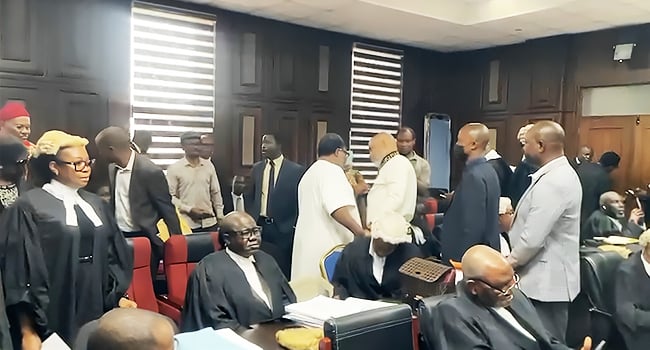
DETAINED leader of the Indigenous People of Biafra (IPOB), Nnamdi Kanu, on Thursday, October 23, disengaged his team of lawyers in his ongoing terrorism trial.
When the case was called, Kanu Agabi (SAN), who had led Kanu’s legal team until Thursday, announced his decision, with other senior lawyers in the team, to withdraw from the case when it was called, “because the defendant has taken this case back from us and we respect that.”
He gave the name of the other Senior Advocates of Nigeria (SANs) withdrawing with him as Onyechi Ikpeazu; Joseph Akubo; Paul Erokoroand Emeka Etiaba (SAN), among others.
As a result, the presiding Judge, Justice James Omotosho, of a Federal High Court in Abuja, adjourned until Friday, October 24, to enable the defendant open his defence.
The Judge then ordered other members of the defendant’s legal team, who were in court, except the SANs, to vacate the courtroom.
Kanu confirmed the development, telling the court that he would be representing himself for now, but noted that the position might change later.
Justice Omotosho asked whether he should assign a lawyer to represent him, but the defendant declined, and began by arguing the jurisdiction of the court to further conduct his trial, but was overruled by the Judge, who insisted that he most proceed with his defence.
At that point, Ikpeazu intervened and drew the attention of the Judge to the fact that Kanu’s lawyers’ withdrawal from the case took effect on the morning of Thursday, praying the court to grant Kanu some time to gather his thoughts and compose himself for the task ahead.
The prosecuting Counsel did not object; hence Justice Omotosho adjourned the case.
Kanu’s disengagement of the lawyers, who took over his defence just this year, was surprising to many in the courtroom, coming barely 24 hours after he met with them preparatory to the proceedings.
At the last hearing on October 16, Justice Omotosho granted the defendant six consecutive days, beginning from October 23, to open and close his defence, in view of the accelerated hearing earlier granted in the case.
At that sitting, the defendant had listed former attorney general of the federation and minister of Justice, Abubakar Malami; Minister of the Federal Capital Territory (FCT), Nyesom Wike; Minister of Works, Dave Umahi; Governor of Lagos State, Babajide Sanwo-Olu; a former Army chief, Gen. Tukur Buratai (rtd); a former minister of Defence, Gen. Theophilus Danjuma (rtd) and others as part of his witnesses.
Agabi, a former attorney general of the federation and minister of Justice, later said: “I and other senior advocates no longer represent Nnamdi Kanu. I wish him well.”
Recall that Kanu had several times raised objections against the court’s jurisdiction to conduct his trial. The former trial Judge, Justice Binta Nyako, dismissed his arguments on different occasions before the case was reassigned to Justice Omotosho.
The drama came three days after a protest against his continuous detention, led by rights activist and politician, Omoyele Sowore, in Abuja, on Monday, October 20, calling for his unconditional release.
The case has passed through four Judges of the Federal High Court in Abuja since it commenced in 2015, with several defence teams involved.
Kanu was released on bail from the custody of the Department of State Service (DSS) in 2017, but fled the country after soldiers invaded his home in Afara-Ukwu, Abia State, in September that year, thereby stalling his trial until he was rearrested in Kenya and brought back to Nigeria in June 2021.
The Court of Appeal, Abuja Division, set him free in October 2022, after striking out the terrorism charges against him on the grounds of the illegality of the manner of his repatration from Kenya.
The Supreme Court, however, overturned the that decision in December 2023 and ordered the trial to continue at the Federal High Court, ruling that there is no Nigerian law that prohibits the use of “illegally obtained evidence for the trial of a defendant.”
The prosecution subsequently opened and closed its case, calling five witnesses.
Kanu, a dual citizen of Nigeria and the United Kingdom (UK), is facing a seven-count charge bordering on terrorism brought against him by the Federal Government, which accused him of inciting violence that led to killings and destruction of property for years in the Southeast states.


