
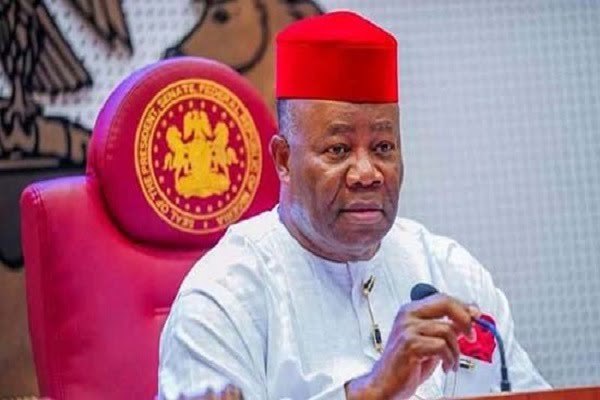
*Abaribe: Votes and Proceedings Will Prove Senate Right Or Wrong
*Akpabio Defends Mandatory Electronic Election Results Transmission Rejection
*Says Process Not Complete, Amendments Can Still Be Made, But Chamber Won’t Be Intimidated
THE Senate would on Tuesday, February 10, hold an emergency plenary sitting, as the controversy over its rejection of full electronic transmittion of election results rages, with criticism from a broad spectrum of society.
According to a statement on Sunday, February 8, signed by the Clerk of the Senate, Emmanuel Odo, all senators had been requested to attend the emergency plenary sitting, scheduled for 12noon.
Although the agenda or schedule was not disclosed, the sitting may not be unconnected with the backlash the February 4 rejection of an amendment for mandatory real-time electronic transmission of election results in the Electoral Bill 2026 it passed, after hours of debate.
Rather, the chamber retained the existing provision, while approving reforms to election timelines, penalties for electoral offences and voting technology.
Under Section 60, the lawmakers voted down a recommendation by the Senate Committee on Electoral Matters, which would have compelled presiding officers to upload results to the Independent National Electoral Commission (INEC) Result Viewing (IReV) portal in real time.
The House of Representatives had approved the real-time electronic transmission of results through INEC’s IReV and Nigerians and election stakeholders had expected the senate to follow suit.
Even the real amendment approved appears to be in contention, with Enyinnaya Abaribe, representing Abia South, insisting the true position will only be confirmed when the votes and proceedings of the day’s plenary are formally adopted.
Abaribe said the confusion stems from procedural assumptions, rather than a reversal of Senate policy, noting: “This matter remains unresolved until the official legislative record reflects what was agreed.”
He insisted that electronic transmission was actually approved in an Executive Session of the Senate, following consultations by the joint Senate-House Committee on the Electoral Act.
According to him: “The committee met 27 times between 2024 and 2025, engaging INEC, civil society organisations and stakeholders to address gaps exposed in the 2023 elections.
“Courts held repeatedly that INEC guidelines were not law. That is why we agreed to put electronic transmission clearly into the Electoral Act.”
The confusion is due to lawmakers assumption that executive session decisions would carry automatically at plenary, as many senators believed the issue had been settled, leading to media reports that electronic transmission had been replaced with “transfer.”
Abaribe said “that was why people were surprised when reports emerged that electronic transmission had been replaced with ‘transfer,” stressing that the Votes and Proceedings, the Senate’s official daily record, will definitively confirm the chamber’s decision, and until it is formally adopted, public certainty cannot be guaranteed.
“This process is not complete until the Votes and Proceedings are presented and adopted. That is when we will know whether what we passed is electronic transmission or something else,” he stated.
Warning that if the final record weakens real-time transmission, senators who supported it will formally challenge it on the floor, adding: “Transmission in real time leaves no room for discretion. That is why Nigerians are insisting on it, and that is why we are insisting that the Votes and Proceedings must reflect it clearly.
“Call your senators and members of the House. Tell them clearly what you want. The integrity of the senate and the credibility of future elections depend on what is finally written and adopted.
“Every time results are delayed or manipulated, people lose faith. Clear, legally backed electronic transmission ensures that elections are transparent and credible.
“If you came on the mandate of the people, why would you want anything murky? Let it be clear. Let Nigerians know exactly what is being passed.”
He said with the Votes and Proceedings pending, Nigerians now have a clear benchmark to hold their lawmakers accountable, adding: “This is where Nigerians must watch closely. The integrity of the Senate and the credibility of future elections depend on what is finally written and adopted.”
Meanwhile, Senate President, Godswill Akpabio, has defended removing the “real-time” from the Electoral Bill 2026.
Speaking at the launch of The Burden of Legislators in Nigeria, written by Senator Effiong Bob, Akpabio argued that mandatory real-time transmission could disrupt elections in case of network failures or power outages, saying: “All we did was remove the word ‘real-time’ to allow INEC to decide the most suitable mode of transmission.
“If it is made compulsory and there is a system failure, it could create serious problems.”
Akpabio said lawmakers deliberately removed the requirement for mandatory “real-time” electronic transmission of election results during the clause-by-clause consideration of the Amendment Bill, due to concerns that enforcing real-time transmission could trigger legal disputes, if network failures occur during elections.
“All we said during discussion was that we should remove the word real-time. Because if you say real-time and the network, or what I may call glitch failure, and then the network is not working, when you go to court, somebody will say it ought to have been real-time.
“That was all we said, but we left the burden to those who conduct elections. INEC will determine the mode of transfer or transmission of votes.
“If we make it mandatory that we must do it real-time, electronically, go and look at what happened in America between George Bush and Al Gore. By the time the votes came in, Al Gore had actually won the election. But what happened?
“George Bush was declared while the votes were still hanging during a trans…electronic vote. Even the best of countries are yet to get it right. That is the first war. But they are more civilized than us.
“In Nigeria, civil society would have called out students and everybody to go to the street; that we have discovered a massive fraud. But they were able to protect their country from disintegrating and protect their democracy from being rubbish.
“So, as we talk, we must have the spirit of what I may regard as patriotism. It is unfortunate.”
He stated that official documents, such as Form EC8A, remain the most reliable instruments for declaring results, warning against lawmakers being pressured by groups, non-governmental organisations (NGOs) or public opinion, adding: “We will do what is right for Nigeria, not what one NGO dictates.”
Stressing that consultations do not amount to law-making, Akpabio said the legislative process is not complete, as amendments can still be made before the Votes and Proceedings are adopted, and rejected provisions could be restored through a Conference Committee between the Senate and House of Representatives.
he senate president said while it is democratic for citizens to criticise the legislature, those dissatisfied with the amendment are free to adopt any method they prefer to transmit election results to collation centres, including using bicycles or mobile phones.
“All institutions have the right to express themselves, thank God democracy is in existence. I must state clearly, without ambiguity, that there’s no fault or insinuation and no midst or misunderstanding. The Senate has acted and when we approve the votes, you’ll see that the Senate has not removed anything.
“If you want to use bicycle to carry your votes from one polling unit to the ward centre, do so. If you want to use your phone to transmit, do so. If you want to use your iPad to do anything, do so. If you have network in your area, go ahead with transmission,” he said.
He questioned the basis of the criticism, accusing his detractors of convening television panels to attack senators over an amendment process that is yet to be concluded.
He challenged the critics, who he described as “mouth legislators,” to contest elections and take seats in the legislature if they wish to participate in lawmaking, adding: “We’re yet to complete the process, so why are people setting up panels in all television studios and then abusing and then people have become mouth legislators.
“Go and contest election if you want to talk about lawmaking and go and join them and make the law. None of them have even been elected councillors, but they are on the television abusing the senators, abusing members of the legislature. But I leave them to God.”
Akpabio reiterated that the senate, under his leadership, would not be intimidated by criticism and would pass an Electoral Act that reflects the interest of Nigerians, saying: “We’ll not be intimidated.
“We’ll do what is right for this country and our expression, our lawmaking will reflect the wishes of the generality of Nigerians, not that of one NGO or somebody who gets money from the European Union to carry senators to Lagos and then ask them for account and then hand over (to) them a paper and say go and pass, that is not lawmaking.
“Retreats are not lawmaking; retreats are part of consultations. So, why do you think that paper you agreed on in Lagos during retreat is what must be agreed on the floor.
His comments is the clearest indication yet that the chamber could reconsider the amendment, as public anger grows.
Alaready, a group, #FixPolitics Africa, while condemning the chamber’s handling of the amendment, described the removal of mandatory electronic transmission of election results as “a direct assault on electoral integrity and public trust.”
In a statement by its, Executive Director, Anthony Ubani, #FixPolitics Africa, demanded the immediate restoration of mandatory e-transmission, which it said was a non-negotiable safeguard of credible elections.
It knocked the senate for creating confusion, contradiction and contempt for the popular will at a time Nigerians demanded transparency and reform, adding: “A Bill touching the very foundation of our democracy was passed under a cloud of dispute, with senators openly alleging that the version announced as ‘passed’ is not the version they voted for.
“This is grave, dangerous and unacceptable in any democracy that takes itself seriously.”
Citing alleged alterations to a tax law after passage by the National Assembly, the statement said: “When lawmakers dispute the content of laws, citizens lose faith. Repeated breaches of trust hollow democracy.”
The group stated that refusing to make e-transmission mandatory, despite years of citizen advocacy and lessons from past elections, exposes a legislature disconnected from electoral realities, noting: “Nigerians did not ask for loopholes; they asked for certainty. Instead, they got ambiguity by design.”
The statement described the chamber’s action as deliberate mischief and an abuse of public trust, reiterating that repeated disregard for citizens’ demands erodes democracy gradually, rather than in a single dramatic moment.
It demanded a full public clarification of the provisions passed, release of the final text of the Bill, a transparent review process to resolve discrepancies and accountability from senate leadership, saying: “Nigeria’s democracy cannot survive on half-truths and broken processes.
“Elections cannot inspire confidence if lawmakers themselves sow doubt.”
While insisting that the senate must choose to protect the vote or risk standing exposed before history, it added: “Nigeria deserves laws that protect the vote, not weaken it. Anything less is a brazen betrayal of public trust.”


