
*Says Affects American Exporters
THE United States (US) has slammed Nigeria’s ban on 25 product categories, insisting the action hampers American exports and deepens trade tensions.
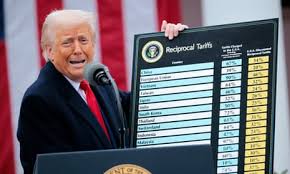
This came in the wake of US imposition of 14 per cent tariff on Nigeria’s export to the country during a global tariff on goods and services from countries across the world announced by President Donald Trump last week.
The US Trade Representative (USTR) in a post on X, listed the Nigerian restrictions on beef, poultry, fruit juice, pharmaceutical and spirits among the top 10 unfair trade practices by foreign nations, adding: “These policies create significant trade barriers that lead to lost revenue for US businesses looking to expand in the Nigerian market.”
The 14 per cent tariff imposed by the US on Nigeria was ostensibly in protest of the latter’s import ban on 25 different product categories that it said had impacted its exporters.
According to the USTR, the ban, particularly in agriculture, pharmaceuticals, beverages and consumer goods, negatively impacted US trade balance with Nigeria, saying: “These policies create significant trade barriers that lead to lost revenue for US businesses looking to expand in the Nigerian market.”
The USTR had on March 31, submitted this year’s National Trade Estimate (NTE), a yearly report detailing foreign trade barriers faced by US exporters and USTR’s efforts to reduce those barriers, to Trump and US Congress.
The NTE report, according to ThisDay, alleged that the Nigeria Customs Service (NCS) had continued to ban the import of 25 different product categories, including bird eggs, cocoa butter, powder and cakes; pork, beef, live or dead birds, refined vegetable oil and fats, practices it alleged had continued to present major obstacles to trade.
Others were bottled water, spaghetti and other noodles; fruit juice in retail packs, tomatoes, tomato ketchup, and tomato sauces; nonalcoholic beverages (excluding energy drinks), bagged cement, beer and stout, all medicaments falling under Harmonised System headings 3003 and 3004; soaps and detergents, mosquito repellant coils, paper board, used motor vehicles more than 12 years old, ball point pens, most types of footwear, bags and suitcases, used clothing, and certain spirits and alcohols.
The report also pointed to non-tariff, electronic commerce/digital, services and technical barriers trade barriers including sanitary and phytosanitary restrictions, and raised concerns about maritime administration.
It said: “Importers report inconsistent application of customs regulations; lengthy clearance procedures, often due to outdated manual processing systems; and corruption. These factors sometimes contribute to product deterioration and result in significant losses for importers of perishable goods.”
The NTE also raised concerns that disputes among public agencies over the interpretation of regulations often caused delays, adding that frequent changes in customs guidelines slow the movement of goods through Nigerian ports.
The USTR lamented that though the Customs authority had attempted to automate its processes, many basic customs procedures were still paper-based and require an unreasonably long time to complete, noting: “On September 2, 2020, the Nigerian Government approved a $3.1 billion customs modernisation project that would include the automation of paper-based customs processes.
“The project was to be completed in 36 months and executed via a public-private partnership through a 20-year concession. This project has experienced implementation delays and is the subject of domestic litigation.
“Nigeria requires that all food, drug, cosmetic and pesticide imports be accompanied by certificates from manufacturers, third-party certifiers, or exporters’ national authorities, depending on the product.
“These certificates must attest that the product is safe for human use and consumption, even though certificate-issuing authorities do not inspect every shipment of exported food product.
“However, Nigeria’s limited capacity to review certificates, carry out inspections and conduct testing has resulted in delays in the clearance of food imports and has diverted imports to informal channels.
“Since 2019, the US has sought to negotiate import permits for the export of several categories of U.S. food and agricultural products. Nigeria has been slow to approve these requests.”
It further expressed concerns by US companies about corruption and a lack of transparency in the country’s procurement processes, stating: “The Public Procurement Act of 2007 established the Bureau of Public Procurement (BPP) as the regulatory authority responsible for the monitoring and oversight of public procurement in Nigeria.
“Only majority Nigerian-owned companies may bid on procurements above 2.5 million (approximately $1,600 thousand), up to 100 million (approximately $64,000 thousand) for goods, and up to 1 billion (approximately $640,000 thousand) for services and works.
“Above those thresholds, both majority foreign-owned and majority Nigerian-owned companies may engage in competitive bidding.
“Nigerian Government agencies do not always follow procurement guidelines, despite the requirement that no procurement proceedings are to be formalised until the procuring entity has ensured that funds are available to meet the obligations and has obtained a Certificate of ‘No Objection’ to Contract Award from the BPP.
“Executive Order 5 of 2018 added restrictions and obligations for public procurement related to science, engineering, and technology. The order is designed to bolster the Public Procurement Act of 2007 and directs government offices to grant preference to Nigerian suppliers.
“Foreign companies may be subject to requirements that include the use of a local partner firm or requirement to join a consortium. Nigeria has made modest progress on its pledge to conduct open and competitive bidding processes for government procurement.
“The BPP has made a variety of procurement procedures and bidding information publicly available on its website.
“However, Nigeria’s National Assembly operates its own procurement process that is not subject to BPP oversight and lacks transparency. Although U.S. companies have won contracts in various sectors, difficulties in receiving payments are common and can discourage firms from bidding.
“Foreign government-subsidised financing arrangements appear in some cases to be a crucial factor in the award of government procurements. Nigeria is neither a Party to the WTO Agreement on Government Procurement (GPA), nor an observer to the WTO Committee on Government Procurement.”
It expressed concerns over alleged Foreign Exchange (FX) controls, saying liquidity limitations have negatively impacted investment as well as trade, while restrictive measures have hampered some US companies’ abilities to import finished or semi-finished goods for use in their Nigerian operations.
According to ThisDay, the report added: “Moreover, Nigeria’s policies have increased challenges for projects developed with international financing that include US dollar-denominated debt obligations, as borrowers have struggled to secure the necessary foreign exchange to meet those obligations.
“In addition, Nigerian importers report they sometimes must agree to schemes to produce domestically in order to be allocated import permits by the government and to access foreign exchange through the Nigerian Foreign Exchange Market to source similar products from abroad.
“However, the Nigerian Government has taken steps to address these limitations. On June 14, 2023, the Central Bank of Nigeria (CBN) introduced a market-based foreign exchange regime, collapsing its multiple official exchange rates into one, the ‘Nigerian Foreign Exchange Market.’
“On October 13, 2023, the CBN reversed its eight-year-old restriction on access to U.S. dollars for the importation of 43 items such as rice, meat, poultry, vegetable oil, fertilizer, dairy products, maize, sugar and several steel products (although, as noted in the Import Bans subsection, some of these products remain on the Nigeria Customs Service’s Prohibited Items List).
“The CBN had accrued an estimated $7billion in backlog of foreign currency orders for companies trying to repatriate their earnings over the past years.
“In March 20, 2024, the CBN announced it had settled $4.6 billion of claims that had been ‘validated’ by an audit conducted by an international auditing firm on behalf of the CBN. The remaining estimated $2.4 billion of backlog was still under investigation by the CBN for their validity as of December 31, 2024.
“Despite the liberalisation of the foreign exchange market, the CBN maintains stringent controls over the repatriation of funds. Companies report that the approval process for the repatriation of funds remains a significant barrier to investment by U.S. entities, as it is frequently subject to delays and denials.”


