

WORLD leaders have been reacting to the emergence of 69-year-old former Cardinal Robert Prevost from Chicago, Illinois, the first ever from the US, as Pope Leo XIV, with many of them expressing eagerness to work with him on global issues, even as he is expected to build on Pope Francis’ reforms.
Pope Leo XIV, who spent much of his career as a missionary in Peru, South America, became the new head of the Catholic Church on Thursday, May 8.
Second black smoke rose from the chimney of the Sistine Chapel, meaning Cardinals in the Conclave have not yet decided on a successor to Pope Francis.
The next vote took place at approximately 17:30 (16:30 BST) on Thursday, and this time, white smoke emerged, meaning a new Pope had been chosen.
According to CNN, Irish Taoiseach Micheál Martin said he hopes “that this ground swell of best wishes toward Pope Leo XIV will give him strength and support as he takes on the immense responsibility of his pontificate
In a statement on X, he also said he looks forward to working with Leo “in addressing the many and interlinked challenges facing our world.”
Spanish Prime Minister Pedro Sánchez congratulated the church in a post on X, saying he hopes Leo’s “pontificate contribute to strengthening dialogue and the defense of human rights in a world in need of hope and unity.”
European Council President, António Costa, and European Commission President, Ursula von der Leyen, said in a joint statement they “are confident that Pope Leo XIV will use his voice on the global stage to promote these shared values and encourage unity in the pursuit of a more just and compassionate world.”
They said the European Union (EU) was ready to work with the new leader “to confront global challenges.”
United Arab Emirates (UAE) President, Mohamed Bin Zayed, in a post on X, sent his “sincere best wishes to His Holiness Pope Leo XIV on his appointment as head of the Catholic Church and wish him success in continuing to promote mutual understanding, peace, and harmony throughout the world.”
Ukrainian President, Volodymyr Zelensky, said on Telegram: “Ukraine highly appreciates the consistent position of the Holy See regarding the adherence to international law, the condemnation of the military aggression of the Russian Federation against Ukraine and the protection of the rights of innocent civilian citizens.”
His Russian counterpart, Vladimir Putin, sent a congratulatory Telegram to Leo upon his election, saying: “I wish you, Your Holiness, success in fulfilling the high mission entrusted to you, as well as good health and well-being.”
Colombian President, Gustavo Petro, on X, said Leo is “more than American,” highlighting his time spent in Peru, adding: “I hope he is the great leader of the migrant people in the world and hopefully he encourages our Latin American migrant brothers, today humiliated in the United States.”
Lebanese President, Joseph Aoun, according to the government’s official account on X, said he was praying for the “success in these efforts to spread the message of love and peace throughout the world, to promote dialogue between different religions and cultures, and that his reign be filled with achievements that serve all of humanity.”
Leo becomes the first American-born Pope, the second from the Americas, following Pope Francis, and the first Augustinian to lead the church.
Even before his name was announced from the balcony of St Peter’s Basilica, the crowds below were chanting ‘Viva il Papa,’ Long live the Pope.
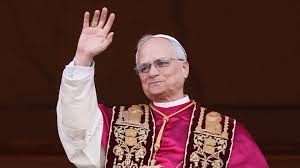
In his first remarks as Pope from the balcony of St. Peter’s Basilica, Leo, a Villanova University graduate, who most recently led a powerful Vatican office for bishop appointments, called for peace and paid tribute to the late Pope Francis to a roaring crowd.
“We still hear in our ears the weak, but always courageous voice of Pope Francis who blessed us.
“United and hand in hand with God, let us advance together,” he told cheering crowds.
There were 133 voting Cardinals and any one of them needed two-thirds of the vote to become the next Pope.
White smoke billowed above the Sistine Chapel earlier in the afternoon, signaling the selection of a new pontiff. Take a look at how the voting process worked.
When Pope Francis stepped onto the balcony of St. Peter’s Square in 2013, he did so in a simple white robe, doing away with much of the pomp that shrouds the papacy.
But when Pope Leo XIV revealed himself to the world, he was wearing the traditional papal robes.
In reverting to norms, perhaps he wanted to show he isn’t trying to clone Francis’ papacy.
As 80 per cent of the Cardinals who took part in the Conclave were appointed by Francis, it is not all that surprising that someone like Leo was elected, even if he was only recently appointed.
He will be seen as a figure who favoured the continuity of Francis’ reforms in the Catholic Church and is believed to have shared Francis’ views on migrants, the poor and the environment.
As Cardinal, he has not shied away from challenging the views of the US Vice President, J.D. Vance, reposting a social media post critical of the Trump administration’s deportation of a US resident to El Salvador, and shared a critical comment piece written about a television interview given by Vance to Fox News.
According to the post: “JD Vance is wrong: Jesus doesn’t ask us to rank our love for others,” in an apparent echo of the writer’s views.
Although he is an American, and will be fully aware of the divisions within the Catholic Church, his Latin American background also represents continuity after a Pope who came from Argentina.
During his time as Archbishop in Peru, he has not escaped the sexual abuse scandals that have clouded the church, but his Diocese fervently denied he had been involved in any attempted cover-up.
Before the Conclave, Vatican spokesman, Matteo Bruni, said during gatherings of the College of Cardinals in the days before the Conclave they emphasised the need for a Pope with “a prophetic spirit capable of leading a Church that does not close in on itself, but knows how to go out and bring light to a world marked by despair.”
Leo is now tied for the fourth most common name chosen by Popes, along with Clement. Only John, Gregory and Benedict have proven more popular.
But we haven’t had a Pope Leo in over a century.
The last Pope Leo was Leo XIII, who was born in French-occupied Rome in 1810 and served as Pope from 1878 until his death in 1903, making his 25-year papacy the fourth longest in the church’s history.
Leo XIII, remembered as a Pope of Catholic social teaching, wrote a famous open letter in 1891, reflecting on the technological changes wrought by the Industrial Revolution and its impact on workers.
In choosing to revive the name, Leo XIV may be signaling the priorities for his papacy.
The first Pope Leo, who served in the fifth century, is known as “Leo the Great” and is remembered for persuading Attila the Hun to halt his invasion and spare the Roman Empire from destruction.
Their meeting was captured in a painting by Raphael, now displayed in the Vatican’s Apostolic Palace, which the 133 voting Cardinals, including Robert Prevost, now Leo XIV, passed through as they proceeded into the Sistine Chapel on Wednesday for the start of the conclave.
The name Leo derives from the Latin for “lion,” suggesting strength and courage.
Born in Chicago, Illinois, in 1955, Pope Leo XIV graduated from Villanova with a Bachelor’s degree in Mathematics in 1977. He is a member of the Augustinian Religious Order and was elected the top leader of the order twice.
In an article about Prevost’s selection as a Cardinal, the former head of the Augustinian Province of St. Thomas of Villanova, referred to him as “our brother Bob.”
Augustinians are followers of St. Augustine, a North African monk and bishop born in 354 AD, who was keenly aware of human nature and desires for community. The Order says its members are “called to Restlessness,” a quality seen as a “divine gift.”
After Villanova, Leo studied at the Catholic Theological Union of Chicago and was ordained as a priest in 1982.
Before he was named a Cardinal by Pope Francis in 2023, Leo was named Prefect of the Dicastery for Bishops, an office that helps the Pope make bishop appointments around the world.
The Chicago-born pontiff also spent two decades in Peru as an Augustinian missionary and later as the Bishop of Chiclayo, Peru. He’s also a citizen of Peru.
He went on to earn a Masters of Divinity from the Catholic Theological Union in Chicago and later studied Canon Law at the Pontifical University of Saint Thomas Aquinas in Rome.
In 1982, at the age of 27, he was ordained a priest in Rome.
His early missionary work took him to Peru, where he served in various roles for over a decade, including as a parish pastor, seminary rector and teacher of Canon Law, Patristics and Moral Theology in the Archdiocese of Trujillo.
In 1999, he was elected Provincial Prior of the Augustinian Province of Chicago, and later served as Prior General of the Augustinian Order from 2002 to 2008.
In 2014, Prevost was appointed Apostolic Administrator of the Diocese of Chiclayo by Pope Francis and consecrated as a bishop in December 2014, becoming the Bishop of Chiclayo in 2015 and was later involved in several high-level positions within the Vatican.
He served as a member of the Congregation for Bishops and the Congregation for the Clergy and was appointed Prefect of the Dicastery for Bishops in 2023.
In 2024, Pope Francis elevated him to the rank of Cardinal, assigning him the Titular Church of Saint Monica, with duties including key responsibilities of overseeing the appointment of bishops worldwide and participating in the Synod of Bishops.
Published:

Related articles

Recent articles
