
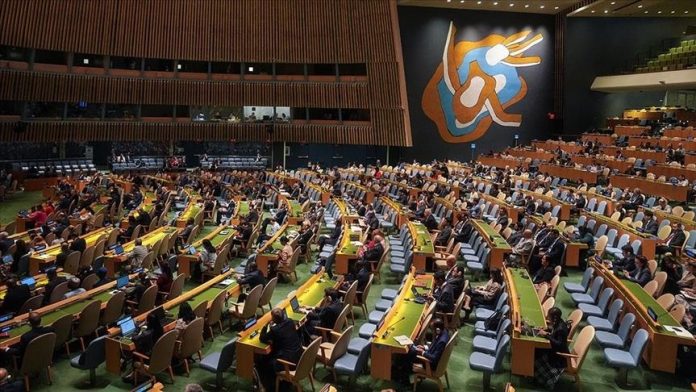
OVER 130 world leaders are expected to meet at the United Nations (UN) next week, faced with wars in the Middle East and Europe threatening to spread, frustration at the slow pace of efforts to end those conflicts and worsening climate and humanitarian crises.
While the conflict between Israel and Palestinian militant group, Hamas, in the Gaza Strip, and Russia’s war in Ukraine are set to dominate the annual high-level UN General Assembly, diplomats and analysts said they don’t expect progress toward peace.
“The wars in Gaza, Ukraine and Sudan are going to be the three main crisis-points in focus at the General Assembly.
“I don’t think we are likely to see breakthroughs on any of them,” said Richard Gowan, UN Director at the International Crisis Group.
UN Secretary General Antonio Guterres, last week told Reuters that the wars in Gaza and Ukraine were “stuck with no peaceful solution in sight.”
Concerns about a spillover of the Gaza conflict to the broader Middle East have again escalated after Lebanese militant group, Hezbollah, accused Israel of detonating pagers and hand-held radios in two days of deadly attacks.
Israel has not commented on the accusation.
“There is a serious risk of a dramatic escalation in Lebanon, and everything must be done to avoid that escalation,” Guterres told journalists on Wednesday, September 18.
The war in besieged Gaza was triggered by a Hamas attack on civilians in Israel on October 7, last year, two weeks after world leaders finished their annual gathering last year.
Mediation efforts by the United States (US), Egypt and Qatar have yet to broker a ceasefire and global patience has waned nine months after the UN General Assembly overwhelmingly demanded a humanitarian truce and as the Gaza death toll reaches 41,000.
Israeli Prime Minister, Benjamin Netanyahu, who has long accused the UN of being anti-Israel, and Palestinian President Mahmoud Abbas, are both scheduled to address the General Assembly on September 26.
The annual gathering of world leaders to mark the beginning of each new session of the General Assembly is often referred to as diplomatic speed-dating.
While the event is anchored by six days of leaders’ speeches to the assembly, much of the action happens on the sidelines, with hundreds of bilateral meetings and dozens of side events seeking to focus the global spotlight on the main issues.
Also looming this year is the prospect of a new US administration. Republican candidate, Donald Trump, who cut UN funding and called the global body weak and incompetent while in office from 2017 to 2021, faces Democratic candidate and Vice President, Kamala Harris, in the November 5 election.
“Clearly in the back of everyone’s mind is going to be a guy called Donald Trump,” Gowan said, adding: “I think in a lot of the private conversations around the General Assembly … the number one question will be what will Trump do to the organisation.”
This year, side events would be held on the war and humanitarian crisis in Sudan, where famine has taken hold; international efforts to help Haiti fight gang violence and the Taliban crackdown on women’s rights in Afghanistan.
Guterres, on Wednesday, poked fun at himself, saying he has “no power and no money,” noting: “There are two things the Secretary General of the United Nations has, and I have to say that I’ve been using them.
“One is my voice, and nobody will be able to shut it up. And second is the capacity to convene people of goodwill to address and solve problems.”
Western accusations about Iran’s role in the Middle East – Hamas, Hezbollah and Yemen’s Houthis are aligned with Tehran – and support for Russia’s war in Ukraine also shadow this year’s UN General Assembly.
European powers seek to revive efforts to rein in Iran’s nuclear programme, and Iranian and European officials are due to meet in New York next week to test their mutual willingness to engage.
Iran’s comparatively moderate new President, Masoud Pezeshkian, would address the UN on Tuesday, September 24, focusing on “detente, building confidence with the world and de-escalation,” a senior Iranian official said, adding he will also “stress Iran’s right to retaliate” against Israel, if needed.
Ukrainian President Volodymyr Zelenskiy would address the high-level General Assembly gathering for the third time since Russia invaded his country and a meeting on Ukraine of the 15-member Security Council on Tuesday and the General Assembly on Wednesday.
Zelenskiy has a plan to push Russia to diplomatically end the war that he wants to present to US President Joe Biden this month.
He also wants to share it with both of Biden’s potential successors, Harris and Trump.
Some US officials have already been briefed on elements of the plan.
“We think it lays out a strategy and a plan that can work. And we need to see how we can promote that as we engage with all of the countries’ heads of state who will be here in New York … we do have hope to make some progress,” US Ambassador to the UN, Linda Thomas-Greenfield, told journalists on Tuesday.
While Russian President, Vladimir Putin, virtually addressed the General Assembly in 2020 during the COVID-19 pandemic, he has not physically traveled to New York for the event since 2015.
Russian Foreign Minister, Sergei Lavrov, is instead due to speak to the General Assembly on September 28.


