

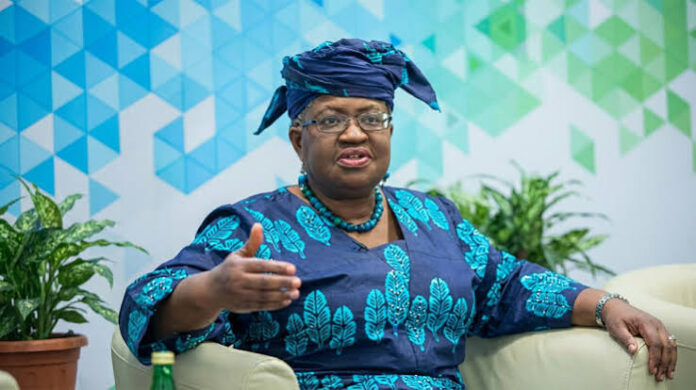
THE Director General of the World Trade Organization (WTO), Ngozi Okonjo-Iweala, has urged Delta State to position itself as a global investment destination by looking beyond Nigeria and taking advantage of emerging opportunities in global trade, supply chain diversification and the African Continental Free Trade Area (AfCFTA).
According to her: “The opportunities are here. The question is whether we will move to seize these opportunities or whether the opportunities will move without us.”
In her keynote address at the Delta State Economic and Investment Summit 2026, in Asaba, on Monday, August 3, Okonjo-Iweala said despite growing geopolitical tensions and disruptions in global trade, unprecedented opportunities still exist for states prepared to attract investment and integrate into global value chains.
Describing herself as “a daughter of Delta,” the former minister of Finance commended Governor Sheriff Oborevwori for his bold and practical leadership, particularly the $100million Viability Gap Fund, designed to de-risk investments in the state, saying that “is exactly the kind of thing that we need.”
Okonjo-Iweala said Delta possesses all the ingredients required to become Nigeria’s next major industrial hub, citing its abundant natural gas reserves, extensive coastline, seaports, railway infrastructure, solid minerals and youthful population, adding: “I am convinced that Delta State has the ingredients to become Nigeria’s next great industrial hub, alongside Lagos, Kano and Port Harcourt, as an engine of the national economy.” The WTO chief stated that Nigeria’s economic transformation can no longer depend solely on the Federal Government, saying subnational governments must lead by attracting investment, creating jobs and driving inclusive prosperity.
She noted: “The Federal Government provides economic stability, state governments convert that stability into shared prosperity, local governments translate that prosperity into a higher standard of living for every family.
“That is what genuine fiscal restructuring looks like in practice.”
She said recent reforms by the Federal Government, including exchange-rate unification, fuel subsidy removal, tax reforms and improved fiscal discipline, have laid the macroeconomic foundation needed for states to pursue aggressive economic development.
She, however, warned that natural resources alone would not guarantee prosperity, as budgetary allocations alone do not lead to development. But execution is what matters.
The former World Bank executive charged the state government to prioritise the development of Special Economic Zones, which she described as one of the most effective tools for attracting manufacturing and foreign direct investment, encouraging it to study successful models, such as the Lekki Free Zone in Lagos and the Glo-Djigbé Industrial Zone in the Republic of Benin.
According to her: “Government creates the enabling environment, while the private sector provides the capital, expertise, innovation and execution needed to bring ambitious projects to life.”
She identified the blue economy as another major growth area, saying Delta’s Atlantic coastline and inland waterways present enormous opportunities in fisheries, marine logistics, port services, seafood processing and ship repair.
Noting that Nigeria currently imports over 570,000 metric tonnes of fish yearly, valued at approximately $866million, she said Delta could position itself as the country’s blue economy hub.
On energy, Okonjo-Iweala stated that expanding gas infrastructure to industrial clusters and economic zones would be critical to supporting manufacturing, mineral processing and broader industrial growth; hence she urged increased investment in digital infrastructure, broadband connectivity and artificial intelligence.
Noting that the future of global trade is increasingly digital, she added: “Our young people are already embracing the digital economy. What they need is reliable broadband infrastructure that enables innovation, productivity and global competitiveness.”
She expressed optimism that Delta State could become a diversified, resilient and globally competitive economy capable of serving as a model for Nigeria and the African continent, enthusing: “Delta State can transform itself from a resource-rich state into a diversified, competitive and inclusive industrial economy.”
Published:

Related articles

Recent articles
