
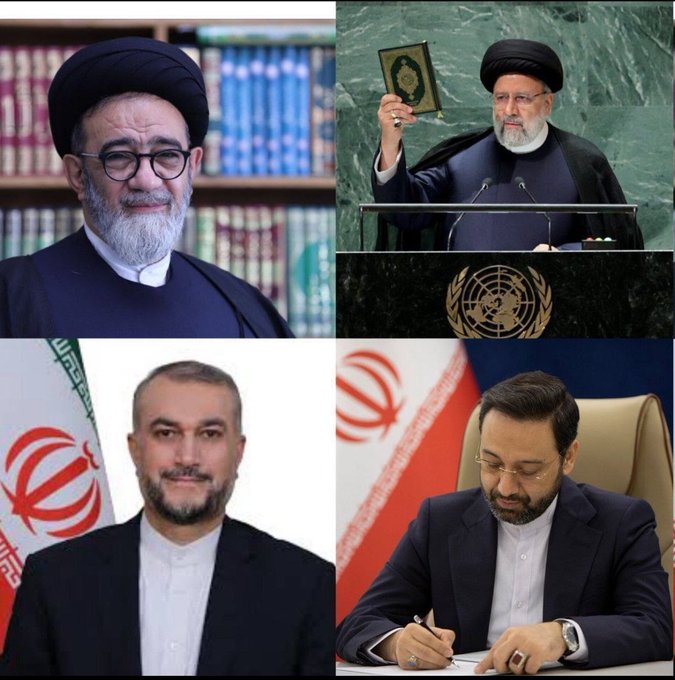
*All Nine Victims Identified
*Fireworks In Tehran Over President’s Death
*Hamas Raises ‘Great Concern’ Over Crash
*Cabinet Holds Emergency Session- State Media
PRESIDENT Bola Tinubu has extended his condolences to the government and people of the Islamic Republic of Iran over the passing of President Ebrahim Raisi and others, including Foreign Minister, Hossein Amir-Abdollahian, in a helicopter crash on Sunday, may 19.
A statement by the Special Adviser to the President on Media and Publicity, Ajuri Ngelale, on Monday, May 20, in Abuja, said Tinubu expressed grief over the tragedy, describing Raisi as a leader who was committed to the development of Iran.
Ngelale said that while commiserating with the bereaved families, Tinubu prayed for the continuous peace, stability and prosperity of the Iranian nation.
“On behalf of the government and people of Nigeria, the President assures the Islamic Republic of Nigeria’s support and prayers in this moment of grief,” he said.
Iran’s Supreme Leader, Ali Khamenei, on Monday announced the death of Raisi and others and declared five days of public mourning, offering his condolences “to the dear Iranian nation.”
Khamenei wrote in a series of posts on X handle: “With deep sorrow and regret, I have received the bitter news of the martyrdom of the people’s President, the competent, hard-working Haj Sayyid Ebrahim Raisi, and his esteemed entourage.
“This bitter tragedy took place while he was serving the people. The entire period that this great, self-sacrificing man held various responsibilities, both during his presidency and before that, he was totally dedicated to serving the people and Islam nonstop.
“Prominent figures, such as the Tabriz Friday Prayer Leader, Hujjat al-Islam Ale-Hashem; the diligent, active Foreign Minister, Mr. Amir-Abdollahian; and other individuals who were accompanying them also passed away in this bitter tragedy.”
Others were Governor of Iran’s East Azerbaijan Province, Malik Rahmati; representative of the Iranian Supreme Leader to East Azerbaijan, Ayatollah Mohammad Ali Al-Hashem; Head of Raisi’s guard team, Sardar Seyed Mehdi Mousavi; Pilot, Col. Seyed Taher Mostafavi; Co-pilot, Col. Mohsen Daryanush, and Flight Technician, Major Behrouz Ghadimi.
Meanwhile Khamenei also asked Vice President, Mohammad Mokhber, to assume interim duties as president and work with the heads of the country’s legislature and judiciary to prepare for a presidential election within the mandatory 50 days.
Iran’s cabinet has also appointed Deputy Foreign Minister, Ali Bagheri Kani, as acting foreign minister.
On Monday, the Iranian Red Crescent confirmed that the bodies of the president and others who died in the crash had been recovered and search operations ended.
The British Broadcasting Corporation (BBC) quoted an official as saying: “We are in the process of transferring the bodies of the martyrs to Tabriz (in Iran’s northwest).”
Islamic Revolution Guards Corps (IRGC) affiliated news outlet, Tasnim, on Monday reported that Raisi’s funeral would be held on Tuesday, May 21, in Tabriz.
In Tehran and other places, some Iranians were in joyful mood over the death of Raisi, nicknamed the ‘Butcher of Tehran,’ followed the official announcement by Khamenei, as well as at the shrine of Imam Reza and Iranian television of the death of the President, the Minister of Foreign Affairs and others after a helicopter carrying them crashed in a mountainous and forested area of the country in poor weather.
Initial reports said the victims were burnt beyond recognition, but Iranian government later clarified that all the nine people killed in the crash had been identified.
A high-ranking government representative told the Iranian news agency, Tasnim, that in spite of the severe burns, the identities of all occupants of the helicopter were established on Monday.
Their bodies have since been transferred to Tabriz, the capital of Iran’s East Azerbaijan Province.
A senior Imam from Tabriz, who led the Friday prayers in the city (Ale-Hashem), was on the aircraft. He was reported to have been alive for about an hour after the crash and was able to contact the presidential office before succumbing to his injuries.
Several hours after the crash, it was not certain who was on board the ill-fated helicopter and their fate until the official announcements, confirming the fears of most Iranians.
In some parts of the capital city, Tehran, and other cities, Iranians defied a call by the Supreme Leader, Ayatollah Ali Khamenei, for prayer for Raisi, as they instead celebrated. Some citizens also begun shooting fireworks in celebration of hopes that their president had actually died.
Israel has already confirmed that it had nothing to do with the crash, making many observers to believe that he may probably have died from the antics of internal enemies.
The Iranian cabinet had convened a second emergency meeting in less than 24 hours following the confirmation of Raisi’s death.
Local media reported on Monday, May 20 that Mokhber had already chaired a meeting on Sunday evening, May 19, after the helicopter went missing with nine people on board over Iran’s northwest.
He was with Amirabdollahian and others as they travelled back from a meeting with the President of neighbouring Azerbaijan, Ilham Aliyev, when their aircraft disappeared from radar on Sunday afternoon.
According to protocol, with Raisi’s death, Mokhber would assume power, pending approval from Khamenei. New elections would then have to hold within 50 days.
The 63-year-old Raisi, a figure representing conservative and hardline factions in Iranian politics, was president for nearly three years and appeared on track to run for re-election next year.
A former chief justice, Raisi was touted as a potential successor to Khamenei, the 85-year-old supreme leader of Iran.
Raisi was born in Mashhad in northeastern Iran, a religious hub for Shia Muslims. He underwent religious education and was trained at the seminary in Qom, studying under prominent scholars, including Khamenei.
Also like the supreme leader, he wore a black turban, which signified that he was a sayyid, a descendant of the Prophet Muhammad, a status with particular significance among Twelver Shia Muslims.
He racked up experience as a prosecutor in multiple jurisdictions before coming to Tehran in 1985, where, according to human rights organisations, he was part of a committee of Judges that oversaw executions of political prisoners.
The late president was a longtime member of the Assembly of Experts, the body tasked with choosing a replacement for the supreme leader in the event of his death.
He became attorney general in 2014 for two years, when he was appointed by Khamenei to lead the Astan Quds Razavi. The colossal bonyad, or charitable trust, has billions of dollars in assets and is the custodian of the shrine of Imam Reza, the eighth Shia Imam.
Raisi initially ran for president in 2017, unsuccessfully challenging the re-election of former President Hassan Rouhani, who represented the centrist and moderate camps.
After a short hiatus, Raisi started making headlines as the new head of the Iranian judiciary system, having been appointed by Khamenei in 2019. He presented himself as a defender of justice and a fighter against corruption and made many provincial travels to garner popular support.
He became president in 2021 amid low voter turnout and wide disqualification of reformist and moderate candidates, and appeared to have secured a firm footing for re-election.
Like other top Iranian officials, his harshest rhetoric was reserved for Israel and the United States (US) and their Western allies.
Raisi made many speeches since the start of the war on Gaza in October to condemn “genocide” and “massacres” allegedly committed by Israel against Palestinians, and called on the international community to intervene.
He promised revenge against Israel after it levelled Tehran’s consulate building in Syria and killed seven members of the Islamic Revolutionary Guard Corps (IRGC), including two Generals, and welcomed Iran’s response, which was to launch hundreds of drones and missiles at Israel, most of which were shot down by a coalition of Israeli allies, but left Iran claiming an overall success.
Raisi was hawkish on Iran’s 2015 nuclear deal with world powers, or the Joint Comprehensive Plan of Action (JCPOA), which has been in limbo after former US President Donald Trump unilaterally withdrew from it in 2018.
He was a champion of the strategic policy of “resistance” and “resilience” that Khamenei has adopted in the face of the harshest-ever sanctions that Iran has faced, imposed after the nuclear deal fell through.
A close ally of the IRGC, the late president was also a staunch backer of the “axis of resistance” of political and armed groups that Iran supports across the region, including in Iraq, Syria, Lebanon and Yemen.
Raisi was a strong backer of Syrian President Bashar al-Assad, who Iran has supported in his government’s war against the Syrian opposition, which has left hundreds of thousands dead.
Meanwhile, Hamas has issued a statement voicing “great concern” after the helicopter crash and subsequent death of Raisi and others on Sunday.
The group expressed “solidarity” towards the president” and the “brotherly Iranian people,” adding: “In this painful incident, we express our full solidarity with the Islamic Republic of Iran, its leadership, government and people.”


