
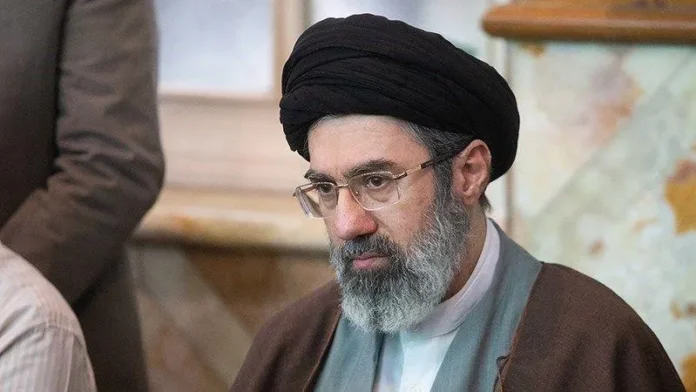
*Says He Won’t ‘Last Long’ Without My Approval
UNITED States (U.S.) President, Donald Trump, on Monday, March 9, said he was not happy with the selection of Mojtaba Khamenei to succeed his late father as the country’s Supreme Leader, stressing: “I am not happy Mojtaba Khamenei is selected as Iran’s new Supreme Leader.” Trump said late on Sunday shortly before Iran chose Mojtaba to succeed his late father as the country’s Supreme Leader, on Monday, March 9, that the new leader “is not going to last long” if the Iranians don’t get his approval first.
Trump told ABC News: “He’s going to have to get approval from us. If he doesn’t get approval from us, he’s not going to last long. We want to make sure that we don’t have to go back every 10 years, when you don’t have a president like me that’s not going to do it.
“I don’t want people to have to go back in five years and have to do the same thing again or worse let them have a nuclear weapon.”
When asked if he would be willing to approve someone with ties to the old regime, Trump replied: “I would, in order to choose a good leader, I would, yeah, I would. There are numerous people that could qualify.”
Speaking to Fox News, he said Iran had previously aimed hundreds of missiles at countries across the Middle East, but the regional balance had shifted after recent US military actions, insisting the U.S. had dealt Iran a severe blow and Tehran’s capabilities significantly weakened.
He urged ships not to fear crossing the Strait of Hormuz, despite rising tensions in the region.
According to the BBC report, the 56-year-old Mojtaba Khamenei is expected to continue the hardline rule of his father, who was killed on the first day of the US-Israeli strikes.
Unlike his father, Mojtaba has largely kept a low profile. He has never held government office or given public speeches or interviews, and only a limited number of photos and videos of him have ever been published.
But for years, there have been rumours that he held considerable influence behind the scenes in Iran.
US diplomatic cables, which were published by WikiLeaks in the late 2000s, described him as “the power behind the robes” who was widely regarded as a “capable and forceful” figure within the regime, according to news agency, AP.
The Islamic Republic was founded in 1979 after the Shia monarchy was overthrown, and its ideology is based on the principle that the supreme leader should be chosen for his religious standing and proven leadership, not through hereditary succession.
During his reign, Ali Khamenei spoke only in general terms about the future leadership of the Islamic Republic.
One member of Iran’s Assembly of Experts, the clerical body that selects the supreme leader, said two years ago that Ali Khamenei opposed the idea of his son being a candidate for future leadership.
But he had never publicly addressed such speculation.
Born on 8 September 1969 in the north-eastern city of Mashhad, Mojtaba is the second of Ali Khamenei’s six children.
He received his secondary education at the religious Alavi School in Tehran. At 17, he served in the military for several short periods during the Iran-Iraq War, according to Iranian media. The eight-year bloody conflict made the regime even more suspicious of the U.S. and the West, which supported Iraq.
In 1999, Mojtaba went to Qom, a holy city considered an important centre of Shia theology, to continue his religious studies.
It is notable that he did not wear clerical clothing until this time, and it is unclear why he decided to attend a seminary at 30, as it is more usual to do so in one’s younger years.
Mojtaba remained a mid-ranking cleric, which some analysts thought could pose an obstacle to his acceptance as the new supreme leader.
Before he was selected, some media outlets and officials close to centres of power in Iran began referring to Mojtaba Khamenei as “Ayatollah,” a senior clerical title.
The shift appeared to some observers as an attempt to elevate his religious standing and present him as a credible leader.
In the seminary system, holding the rank of “Ayatollah” and teaching advanced classes are regarded as indicators of a person’s scholarly level and knowledge, and are considered one of the requirements and prerequisites for a future leader.
But there is already precedent for this. His father was quickly promoted to “Ayatollah” after he became Iran’s second supreme leader in 1989.
Mojtaba’s name first entered the public spotlight during the 2005 presidential election, which resulted in the victory of Mahmoud Ahmadinejad, a populist hardliner.
In an open letter to Khamenei, reformist candidate Mehdi Karroubi accused Mojtaba of interfering in the vote through elements of the Islamic Revolutionary Guard Corps (IRGC) and the Basij militia, which distributed money to religious groups to help Ahmadinejad win.
Four years later, Mojtaba faced the same accusation again. The re-election of Ahmadinejad triggered mass protests across the country, known as the Green Movement, with some protesters chanting slogans opposing the idea that Mojtaba could succeed his father as Iran’s supreme leader.
Mostafa Tajzadeh, the then-deputy Interior minister, who described the result as an “electoral coup,” was imprisoned for seven years, which he attributed to “the direct wish of Mojtaba Khamenei.”
Two reformist candidates, Mir-Hossein Mousavi and Mehdi Karoubi, were put under house arrest after the 2009 election.
In February 2012, Mojtaba met and urged Mousavi to give up his protest, Iranian sources told BBC Persian.
Now, as Iran’s freshly chosen supreme leader, many expect Mojtaba to continue his father’s hardline policies, with some also believing that a man who has lost his father, his mother and his wife in US-Israeli strikes will be unlikely to bow to Western pressure.
But he also faces the daunting task of ensuring the survival of the Islamic Republic and convincing the public that he is the right person to lead the country out of political and economic devastation.
His leadership record remains largely untested, and the perception that the republic is turning into a hereditary system could further deepen public discontent.
Mojtaba is now a marked man, as Israel’s Defence minister said last week that whoever was chosen as Ali Khamenei’s successor would be “an unequivocal target for elimination.”


