
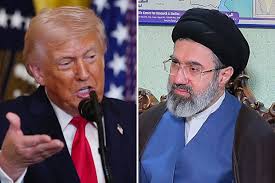
*Trump Says US Agreed To Iran’s Request To Continue Talks, But Ceasefire Over
*Countries Must Reject Iran Efforts To Control Hormuz, Says UN Agency Document
THE United States (US) wants Iran to publicly state that the Strait of Hormuz is open and to pledge to stop firing on commercial ships as part of negotiations due to be held on Saturday.
According to the BBC, US media cited unnamed officials as saying Tehran had privately acknowledged to President Donald Trump’s advisers that the shooting at ships was a mistake, though the Iranians reportedly pinned the blame on a rogue internal group.
Trump has said both sides have agreed to continue talks, despite this week’s fighting over the Strait of Hormuz, which the White House saw as a violation of the ceasefire.
In June, the US and Iran signed a ceasefire agreement where Iran would, in part, give safe passage to commercial ships.
Tehran said an “errant” sect of hardliners was trying to undermine negotiations by firing on the commercial ships, senior US officials told CBS News, the BBC’s US partner.
One official told the television network: “They (the Iranians) came back to the table and said, ‘We screwed up. We made a mistake. Let’s keep talking.'”
In a briefing for reporters on Friday, July 10, the US officials said a message to Tehran’s leadership had been conveyed through regional mediators, demanding Iran release a statement declaring the strait open and that it will stop shooting at commercial ships, according to multiple media reports.
“They’re either going to give us that statement or we’re not having a good outcome for them,” said one official, quoted by Reuters news agency.
The White House also wants Iran to publicly acknowledge that firing on the shipping was a mistake, CBS reports. US Vice President, JD Vance, Secretary of State, Marco Rubio and two people who have been heavily involved in Middle East talks, special envoy, Steve Witkoff, and Trump’s son-in-law, Jared Kushner, are expected to lead negotiations, which were expected to take place in Oman on Saturday, July 11.
Meanwhile, a delegation from Qatar travelled to Iran on Friday for talks aimed at defusing tensions and easing navigation through the Strait of Hormuz.
Trump wrote in a post on Truth Social earlier on Friday: “The Islamic Republic of Iran has asked us to continue ‘talks.’
“We have agreed to do so, but the United States has stated to them, in no uncertain terms, that the Cease Fire is OVER!”
No fresh attacks were reported on Friday after fighting broke out in the Gulf region earlier this week, marking the worst exchange of fire between the US and Iran since the two signed an interim deal in June.
Three ships were struck while using a US-recommended route through Omani waters. Iran has repeatedly said the only “safe” passage is a separate route through its waters.
Overall progress came last month when the US and Iran agreed on a 14-point Memorandum of Understanding (MoU), aimed at extending a ceasefire and ending conflict “on all fronts.”
As part of the agreement, Iran and Oman must hold talks “to define the future administration and maritime services” in the strait with other Gulf states.
During the conflict, Iran sought to assert its sovereignty over the strait, including by establishing the “Persian Gulf Strait Authority,” which it said would manage “safe passage permits.”
Iran’s Fars news agency has reported that under the new deal with the US, the strait would ultimately be managed by Iran, in co-ordination with Oman, including possible “service fees” for ships to transit the waterway.
However, Iran has disputed Trump’s interpretation, saying it had not requested talks with the US, but had agreed to host a Qatari mediator in Tehran, state television reported, citing Iran’s Foreign Ministry spokesperson.
Qatari negotiators meting officials in Iran on Friday to de-escalate tensions and discuss navigation through the Strait of Hormuz, a source with knowledge of the situation told Reuters.
Foreign Minister, Abbas Araqchi, would visit Oman to discuss arrangements for the safe passage of ships through the Strait of Hormuz, ISNA reported, citing the foreign ministry spokesperson.
After Washington accused Iranian forces of attacking three tankers in the area, the US struck military sites in Iran in response.
Iran then attacked US military sites in Gulf states on Thursday.
At least 17 people were killed in US strikes on six cities in Iran on Wednesday and Thursday, the head of the public relations and information center at Iran’s Health Ministry said, adding that 115 people were also wounded.
Even so, US officials said conversations between the two countries had been productive in recent days. “What we’re demanding is that the Iranians issue a public statement that acknowledges all channels of the Strait of Hormuz are open and they’re not shooting at ships anymore.
“They’re either going to give us that statement or we’re not having a good outcome for them,” one official said.
Tehran in turn pledged that any breach of commitments by Washington would be met with “reciprocal action,” the foreign ministry spokesperson said, according to state media.
That interim deal was meant to pave the way to the end of a conflict now in its fifth month that has killed thousands, throttled worldwide energy supplies and raised fears of a global economic downturn.
Iran buried its slain Supreme Leader Ayatollah Ali Khamenei on Thursday at the country’s holiest shrine in Mashhad, capping a week of funeral processions and rallies.
Khamenei was killed in an airstrike on the first day of the war on February 28.
A condolence ceremony was due to be held on Friday after sunset prayers on behalf of Supreme Leader, Mojtaba Khamenei, for his father in the city of Qom, his office announced.
Mojtaba Khamenei, who was injured in the strike that killed his father, has not appeared in public, fueling speculations about his role in Iran’s future.
Meanwhile, the governing council of the United Nations (UN) London-based International Maritime Organisation (IMO) agreed on Friday that countries should reject efforts by Iran to impose sovereignty over the Strait of Hormuz and Tehran’s “unilateral decision” to create a body to control traffic through the waterway.
IMO is responsible for regulating the safety and security of international shipping and preventing pollution and comprises 176 member states.
Protection of vital shipping lanes was discussed at a session this week of its 40-member governing council. Gulf countries, the United States and Iran clashed over the future of the strait.
The IMO Council “strongly condemned” Iran’s decision to “establish an entity purporting to control traffic through the strait,” according to the text of a non-binding decision reached.
The council’s decision called on member states not to recognise “Iran’s claim of sovereignty over the Strait of Hormuz, its assertions of jurisdiction over the maritime zones of third states in and around the strait, which violated the sovereignty, sovereign rights and exclusive jurisdiction of these states” and not to recognise any Iranian decisions aimed at “closing, obstructing, hampering or otherwise interfering with international navigation and right of transit passage.”
Iran’s recently created Persian Gulf Strait Authority, warning on an advisory last month that no vessel was permitted to pass through the waterway “without a valid passage permit” issued by the body.
Iran, which does not have a seat on the council, told IMO delegates this week it rejected “the selective, politically motivated and legally unfounded allegations” made against it.
It was not a party to the UNCLOS international maritime convention and was “not bound by the treaty-based regime,” its IMO delegation said.
“The measures implemented by … Iran are intended to uphold maritime safety and security, prevent the provision of support or assistance to acts of aggression, safeguard Iran’s sovereignty and vital security interests, and ensure that navigation remains safe and non-threatening.
“These measures do not constitute the closure of the strait,” Tehran’s delegation said.


